Starting an online gambling business in Brazil is one of the most popular topics in the industry today because Brazil is considered a high-potential market.
In 2023, President Lula da Silva enacted a turning point in Brazil's sports betting landscape by approving a new law that introduced both online and land-based sports betting licenсes. The law that took effect from 1 January 2025, legalised sports betting and iGaming in the region after years of debate.
The regulatory framework now offers a spectrum of opportunities for both local and international operators, ultimately contributing to the region's economic growth.
Given the positive landscape, let's dive deeper into the market to explore the process of launching an online casino in Brazil and the crucial factors to consider.
Is Online Gambling Legal in Brazil?
It took Brazil decades to provide a clear and positive answer to this question, but now it's a legal 'yes'. As of 2025, sports betting and online gambling are officially authorised in Brazil.
To obtain a licence, operators must establish a local presence. This includes the stipulation that a Brazilian national must hold at least a 20% ownership stake in the company.
A notable, perhaps unwelcome, change was the introduction of a 15% tax on player winnings, which took effect in 2025.
To put it briefly, the new regulation marks a significant step for Brazil, aiming to make gambling safer, support social sectors, and attract investments. It's a positive change that has been anticipated globally for years, but the road to this point has been convoluted.
Brazil’s Path to Online Gambling Regulation
Let's have a closer look at the environment that has fostered the development of online gambling in Brazil.
1946 Blanket Ban
Despite Brazilians' cultural inclination toward entertainment, the betting industry has had a turbulent history. For the majority of the past 80 years, gambling has been illegal in the country, resulting in a halt to industry development. In 1946, a comprehensive ban took effect on all types of land-based gambling, which forced many establishments to close.
2010s
With the advent of the internet, it was generally accepted that iGaming was also subject to these restrictions. In the 2010s, Brazil attempted to clarify its online gambling regulations, only to officially ban it several times.
One notable example occurred in 2010, when the Brazilian Congress attempted to pass a bill that would prohibit financial transactions with online gambling sites within the country. Similarly, in 2013, the Commission of Science, Technology, Innovation, Communication, and Computing (Comissão de Ciência, Tecnologia, Inovação, Comunicação e Informática (CTIC)) voted on a law project aimed at banning online gambling throughout Brazil.
For a long time, the gambling landscape in Brazil was limited to specific forms. There were only two forms of gambling allowed in the country: state-run lotteries and horse race betting. Despite the restrictions and the centralised authority, the initiative was still a significant step towards providing legitimate alternatives for Brazilians.
Legally, poker fell into a relatively grey area. Since poker relies more on skill than on luck, it has been removed from the list of gambling activities. In response, the number of both online and offline poker rooms multiplied. However, the classification and status of poker within the realm of gambling were not clearly defined, as there was no law specifically covering this activity.
2016 and Onwards
Over the years, the iGaming world closely watched the development of Brazil's regulatory framework, as several positive trends have emerged. One of the major changes in Brazil's status quo was achieved in 2016 with the Brazilian Gaming Congress, which attracted many entities interested in exploring and investing in the sector.
Online gambling regulation in Brazil turned a corner in 2018, when the government introduced a law that would create a single framework and unify the fragmented online gambling sector. Due to the impact of COVID-19 and the upcoming 2022 presidential election, the progress of this legislation was postponed. Nevertheless, in 2023, the President endorsed the bill, leading to full regulation of the iGaming industry in January 2025.
Despite delays in the regulatory processes, the Brazilian government remained committed to providing clarity and actively regulating the gambling industry. This effort was driven, among other things, by the goal of stimulating regional economic development. For example, in September 2022, Brazil implemented a new law requiring the introduction of temporary lotteries. The funds raised were designated for healthcare and tourism purposes.
In conclusion, Brazil's federal structure presents both benefits and drawbacks for the online gambling industry. The issue of legality, which has long been a point of uncertainty, now has a clear resolution. This lucidity provides a solid basis for the anticipated growth and flourishing of the online betting sector in the region, according to experts.
Key Updates From 2025
2025 marked a period of significant change for the Brazilian iGaming market, following its official opening in January. While the industry continues to generate considerable attention, the initial “launch chaos” is slowly giving way to consolidation and greater regulatory clarity. Below are the most important updates from 2025 that shaped the market landscape:
January 2025
Law No. 14,790/2023 came into force, establishing Brazil’s regulated fixed-odds sports betting and online gambling market. Operators are to hold a federal licence, operate under the .bet.br domain, and maintain a legal and physical presence in Brazil to lawfully offer services.
March 2025
SPA Ordinance No. 566 requires banks and payment providers to block transactions for unlicensed operators.
April 2025
Ministry of Sports Ordinance No. 36 expanded the list of permitted betting markets to include esports competitions, subject to formal approval from game developers or rights holders.
June 2025
The federal government confirmed an increase in the Gross Gaming Revenue (GGR) tax from 12% to 18%, with the new rate scheduled to take effect from 1 October 2025, directly impacting operator margins and forecasting.
Google authorises licensed betting and online casino apps to be distributed via Google Play Store in Brazil, improving regulated operators’ access to mobile users and reducing reliance on web-only acquisition channels.
October 2025
Under Normative Ordinance No. 615/2024, operators may no longer accept cryptocurrency payments and must rely exclusively on electronic transfer methods.
December 2025
The Chamber of Deputies’ Communications Committee approved Bill No. 4044/2025, strengthening measures against illegal betting.
Brazil’s Online Gambling Market Overview
With a population of 212 million, a 77.87% internet penetration rate, and a historic love of local citizens for various forms of gambling, the Brazilian online gambling market has a lot to offer international operators.
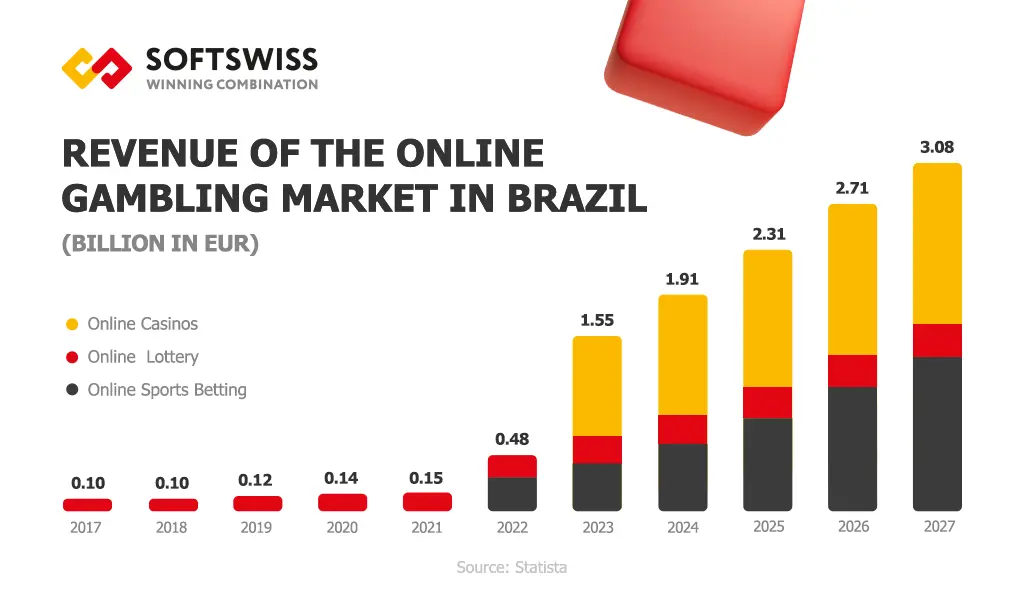
As far as the market size is concerned, the outlook is more than just positive. According to Statista, Brazil's online gambling market will grow at a compound annual growth rate of 18.82% and reach EUR 3 billion by 2027. Their recent regulation establishment supports the prediction and promises even more explosive growth.
There are several social factors that will help iGaming operators develop a solid understanding of today's gambling in Brazil. Simply put, Brazilians are among the most tolerant audiences for online gambling. Brazil's competitive nature, love for football, and desire to have fun explain why the market is so promising.
Free ebook
iGaming Market Overview: Brazil
Explore the Brazilian market and its opportunities with in-depth insights. Download now!
Gambling has also played a significant role in the lives of Brazilians for centuries, taking various forms such as horse racing, lotteries, and bingo.
In terms of the motivation for sports betting, which is the most popular form of gambling in the region, 60% of bettors cite entertainment or recreation as their reason for participating. Sports betting is viewed as a means of socialising with friends by 13% of respondents, while 12% see gambling as a direct source of income, putting them at risk of responsible gambling.
The majority of payment systems are under government control, adding complexity to the endeavour of starting a casino in Brazil. Additionally, cash-based payment options remain highly popular among the public (54% for digital payment methods and 46% for cash, according to market research and data provided by international consulting firms in Latin America).
Must-Have Payment Methods for Entering the Brazilian Online Gambling Market
Pix
Developed by the Central Bank of Brazil, the Pix system enables real-time payments and transfers. This system has gained widespread adoption due to its convenience and accessibility, significantly transforming the country's payment landscape and reducing dependence on traditional banking methods.
Debit and Credit Cards
With increasing digitisation and globalisation, this type of online payment is gaining influence in Brazil. It is important to accept both global payment providers like Visa and Mastercard, as well as local credit cards such as Hipercard and Elo.
It is important for operators to strengthen their anti-fraud efforts, given the popularity of vouchers among the public. Betting vouchers can be purchased offline, making betting anonymous and increasing the risk of fraudulent activity.
For example, vouchers have limitations on the speed at which payments can be processed: it can take up to three days on average, and players can exploit this delay to play with funds that don't belong to their account.
Crypto Gambling in Brazil
Gambling with cryptocurrencies is officially banned in Brazil under the country’s new iGaming regulatory framework. When Brazil launched its regulated online betting market on 1 January 2025, Normative Ordinance No. 615/2024 came into effect, making crypto gambling illegal for licensed operators – meaning platforms can no longer accept Bitcoin or other digital assets for bets and must instead use only traceable electronic transfers.
Languages
As an international language, English is usually present in all online casinos. However, localisation is a no-brainer in countries where English is often a second or third language, if spoken at all.
A site in Portuguese for Brazil is a must, since 98% of the population identifies it as their native language. With multiple locales, an online casino can cater to a larger target audience and deliver a native player experience.
Software Platform Requirements
There are currently no distinctions in licensing between software suppliers and operators in Brazil. Therefore, most suppliers with an eye to offering their casino and sports betting platforms applied for the licences issued by the Brazilian regulator. Their status can be confirmed on the regulator’s official website.
Mobile betting among locals is a popular pastime. Having a well-designed mobile version of your site or app that works on popular systems is a big advantage, especially since Google is available to legally promote your brand. Incidentally, SOFTSWISS is a certified Google Ads partner for iGaming operators and is authorised to manage operator ad accounts.
Brazil’s love for football is a widely acknowledged fact. Not having an offering to bet on the outcome of sports events can have a significant impact on an iGaming business in Brazil.
Integrating a sportsbook solution into your online casino platform and offering a seamless wallet experience between casino and sports can significantly enhance the success of your venture in Brazil.
SOFTSWISS can offer its Casino Platform and Sportsbook as standalone or integrated products to power iGaming brands aiming to succeed in Brazil.
Operators launching in Brazil can rest assured that they will have the online gambling software, games, and payments they need to grow and scale their online brand.
Interactive P&L Sheet
Online Casino Cost Calculator
Start an online casino business journey with a clear understanding of its financial requirements. Download a free calculator now!
Casino Game Preferences in the Brazilian Gambling Market
Brazilians love the game of chance and skills in all of its varieties, from sports betting, lottery, and bingo to the famous Jogo do Bicho.
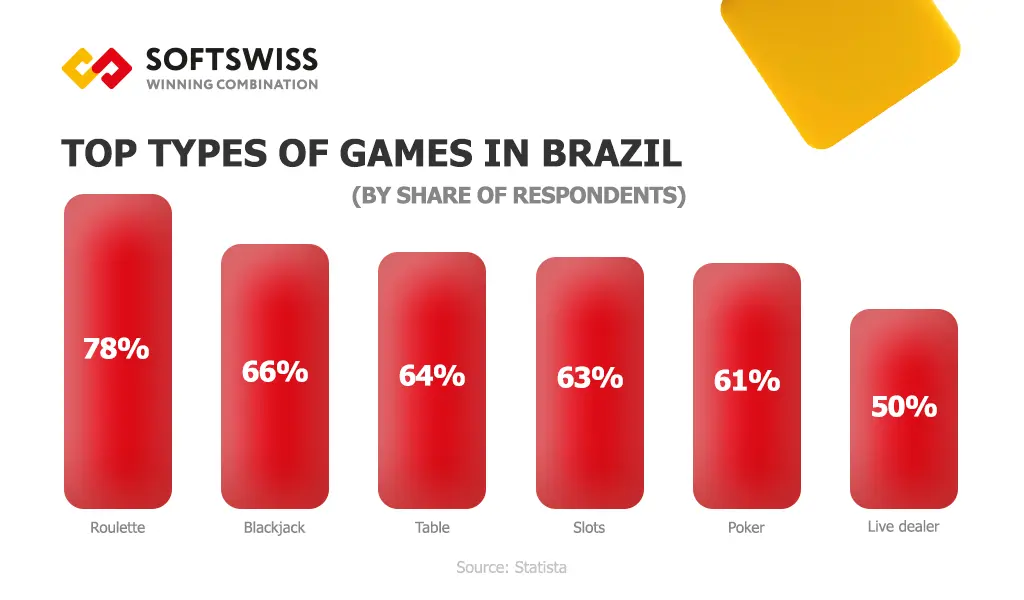
According to Statista, roulette is at the top of the list, a classic casino game that offers thrilling excitement and the chance to win big. Whether it's a European, American, or French version, Brazilians enjoy the thrill and strategy of placing their bets and watching the wheel spin.
Blackjack is another popular game among Brazilian online casino players. Table and card games generally hold a special third place in the hearts of Brazilian players.
Video slots, the eternal and unchanging leader of all the ranks, also have a significant following in the Brazilian online casino scene. Whether traditional three-reel fruit slots or modern video slots with multiple pay lines, Brazilians enjoy spinning the reels, eagerly waiting for a winning combination.
As previously discussed, poker owes part of its popularity to poor regulation of skill-based games, ranking fifth among Brazilian gambling activities.
Lastly, live dealer games have gained immense popularity among Brazilian online casino players. It comes as no surprise that socially active Brazilians are ready to engage in live online gaming and build a vibrant gaming community, as their sense of belonging knows no barriers, neither in real life nor online.
A single connection to the world’s leading content providers with over 40,000 games.
Sports Betting in Brazil
Before we move on to the marketing of online casinos in Brazil, let’s take a look at sports betting. Any operator considering entry into the Brazilian market ideally should recognise the need to seamlessly integrate both casino and sportsbook services under a single iGaming brand. This combination is particularly crucial in Brazil, given the population's passion for sports gambling.
Figures back up the hypothesis: according to the TGM Gambling and Sports Betting Survey, nearly one-third of the population bets on sports several times a week, while 8% bet daily. The fact that Brazil stands as the most populous country on the continent leads to a logical conclusion – the market for sports betting business development here is full of promise.
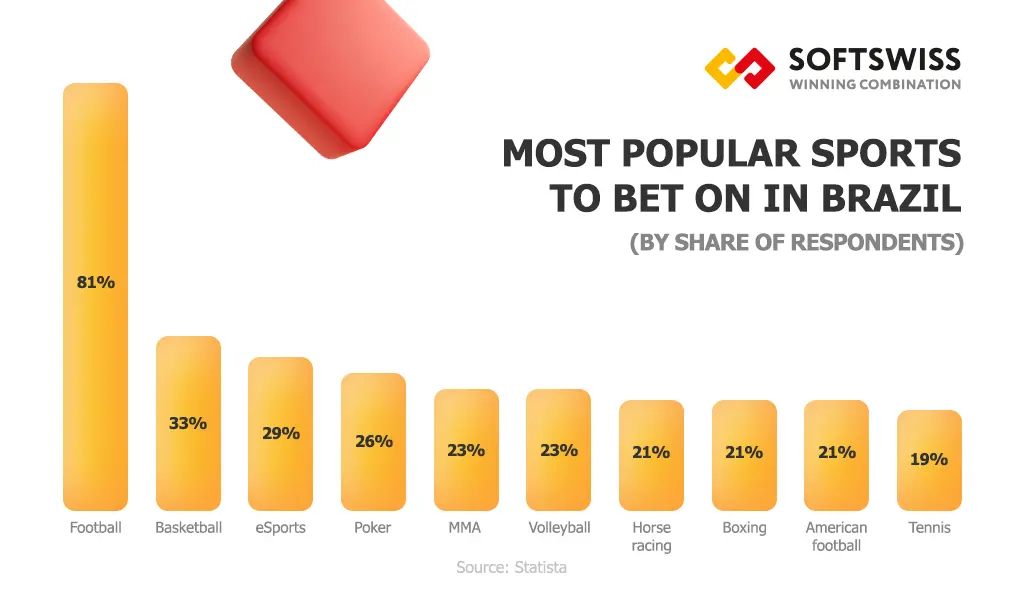
According to Statista's findings, football has a significant lead, followed by basketball, poker, and horse racing.
Moreover, this is where the growing popularity of esports in Brazil comes into play. Statista's report suggests that the esports user base will exceed 24 million by 2027. This emerging market presents a valuable opportunity for bookmakers to tap into, expand their audience, and capture the attention of younger bettors.
Another great potential lies in offering innovative features and services to differentiate your sports betting website from competitors. When it comes to uniqueness and gamification, the SOFTSWISS Sportsbook team holds the top spot.
The sports betting management platform offers four unique bonus types, including jackpots, enabling bookmakers to cater to various audiences. By staying constantly updated on the latest trends, SOFTSWISS provides an exceptional bettor experience that cultivates a loyal player base.
Launch your online sports betting business. Get the essential step-by-step guide.
Marketing to Start an Online Casino in Brazil
The new legislation has opened the landscape of gambling advertising. Licensed companies can run ads to promote their websites while adhering to strict, responsible gambling guidelines. This includes warnings about betting risks, encouraging safe gaming, and avoiding claims about gambling's social benefits.
Traditional digital marketing methods that comply with the local rules are generally a safe bet for Brazil.
As is traditional in iGaming, an effective marketing strategy includes building a network of affiliates, placing brand information on reputable online resources, running pay-per-click campaigns, and using SEO.
Report
2026 iGaming Trends
Explore the future landscape of iGaming with the forward-looking outlook by SOFTSWISS, giving its readers a strategic edge in the market.
A Sleeping Giant Awakens
Brazil has finally moved from regulatory uncertainty to a structured and increasingly stable iGaming market. Licensing has clarified the entry rules, enforcement has strengthened the legal ecosystem, and player demand has settled at a higher, sustainable level. As consolidation begins, significant opportunities remain. The market is competitive and still open to those who are ready to execute.
If you are looking for a reliable partner to enter one of the most talked-about gambling markets, contact SOFTSWISS to support your expansion with confidence and long-term certainty.
A robust, all-in-one solution for running online casinos.
Is iGaming legal in Brazil?
Yes, iGaming is legal in Brazil under a regulated framework. In January 2025, Brazil officially legalised online sports betting and fixed-odds betting, while online casino games (such as slots, roulette, and live casino) are permitted when offered by licensed operators under the new federal regulations.
Who regulates iGaming in Brazil?
The iGaming market in Brazil is regulated at the federal level by the Ministry of Finance, through the Secretariat of Prizes and Bets (SPA). This authority oversees operator licensing, compliance and enforcement, AML and Responsible Gambling requirements, taxation and reporting.
What types of online gambling are legal in Brazil?
Legal forms include online sports betting (fixed odds), online casino games (under licensed operators), and lotteries (federal and state).
How much is the iGaming licence in Brazil?
The cost of obtaining a gambling licence in Brazil is approximately EUR 6 million. In addition, licensed operators are required to pay an 18% tax on Gross Gaming Revenue (GGR).
Can foreign iGaming operators operate in Brazil?
Yes. To apply for a Brazilian online gambling licence, the applicant must be a company incorporated under Brazilian law, with its headquarters and management based in Brazil, and must include a Brazilian partner holding at least a 20% ownership stake. In addition, the company must be structured as an eligible legal entity, either an Ltda. or a Sociedade Anônima (S.A.).
What Responsible Gambling measures are required?
Key Responsible Gambling measures in Brazil include self-exclusion and pause options, player-defined limits on deposits, losses, and playing time, regular reality checks with re-authentication after periods of inactivity, and access to addiction risk assessments and support resources. Operators are also required to maintain a clear Responsible Gambling section and ensure staff are trained in ethical and socially responsible practices.