In 2026, success is not about how many titles your online casino offers. What matters is how thoughtfully your portfolio is structured and whether you can procure content from leading game providers. Operators gaining ground are those who assign each title a clearly defined commercial role and shape their lobby around proven, high-performing content.
The primary risk in most online casino lobbies is not a lack of content but concentration. Over-reliance on a single game category creates GGR volatility, fails to convert non-traditional demographics, and limits long-term player lifetime value.
Key Takeaways
An operator's game portfolio size is not a performance metric. Every title must justify its place by serving a specific commercial role, like acquisition, engagement, retention, or diversification.
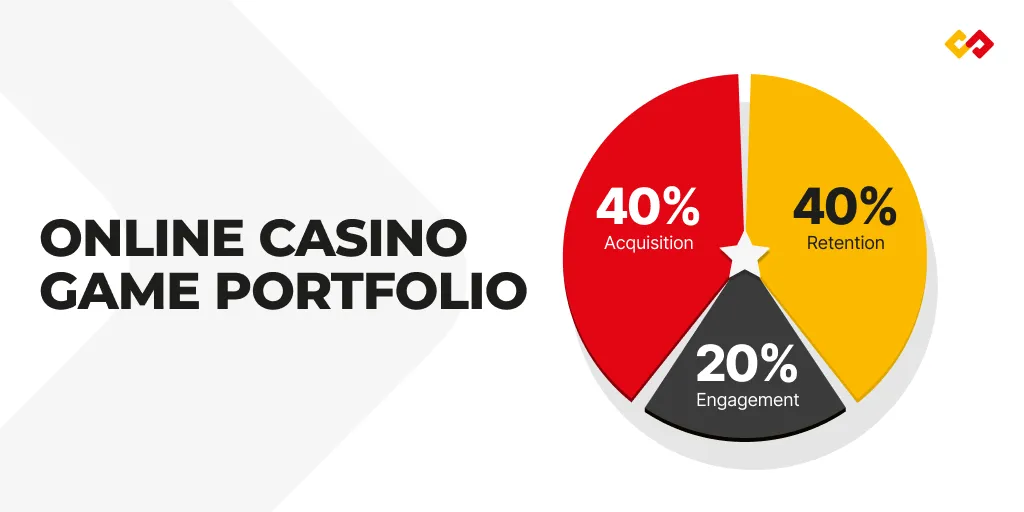
Slot-heavy lobbies can drive strong GGR but carry a higher concentration risk. If one game type loses appeal, performance can drop significantly. A balanced mix – 40% slots, 40% live casino, 20% hybrid – could deliver more stable GGR and higher player LTV.
Hybrids bridge the demographic gap. Traditional content often fails to convert Gen Z. Such formats as crash, arcade, and fishing are the essential vehicles for reaching mobile-first audiences.
For operators managing large, multi-GEO portfolios, aggregation has become the dominant infrastructure approach – offering faster content deployment, unified reporting, and lower technical overhead than managing individual studio integrations at scale.
How to Structure Your Casino Portfolio for Maximum GGR
Before selecting individual game titles, you first need to define how your portfolio will be structured. Without a clear portfolio framework, lobbies naturally drift slot-heavy, and while slots drive ~70–80% of online casino GGR across Europe, over-reliance creates concentration risk, a repetitive library, and fails to convert the mobile-first demographic reshaping acquisition economics.
The highest-LTV operators offset this through deliberate balance across slots, live casino, and emerging verticals – which is where the 40/40/20 model comes in.
The weighting reflects distinct commercial roles:
Slots drive top-of-funnel volume and first-deposit conversion at a cost structure live casino cannot match.
Live casino generates the highest margin per session and concentrates VIP spend.
Hybrid formats (crash, arcade, instant-win) serve the mobile-first, younger demographic that neither slots nor live casino reliably converts.
VIP-focused brands in mature European markets: consider tilting toward live casino within the Retention tier.
The framework gives you a starting point. Your market data, player cohort analysis, and regulatory constraints should drive the final allocation.
Direct Integration Vs. Game Aggregation
Implementing the 40/40/20 model at scale – 5,000 to 10,000+ titles – creates another challenge: gaining timely access to the right studios in each category.
Direct integration offers strong commercial terms and tighter content control, but onboarding 50+ providers independently can typically take 12–18 months, depending on internal development resources, provider API complexity, and compliance requirements – placing significant strain on engineering teams.
Game aggregation addresses this challenge at the infrastructure level. Instead of managing dozens of individual integrations, operators connect through a single API that centralises content access, reporting, and compliance oversight – making it operationally feasible to secure the right mix of studios that best cater to your needs.
Solutions, like the SOFTSWISS Game Aggregator, provide immediate access to a certified, globally accessible library – including the providers referenced in this article – with active selection by GEO and audience profile and pre-certified content for regulated jurisdictions.
Direct Integration vs. Aggregation
Direct Integration
Aggregation
Speed to market
12–18 months for 50+ studios
Days to weeks for 10,000+ titles
Technical maintenance
Operator manages all updates and fixes
Handled entirely by the aggregator
Reporting
Fragmented across multiple dashboards
Unified back-office with real-time data
Compliance
Individual studio vetting required
Pre-certified content included
True cost
Lower headline fees; high internal payroll
Pay for volume; lean headcount
With the sourcing model defined, the next decision is how to structure the portfolio itself. The first category to evaluate is slots – the primary engine of revenue and player acquisition.
Slots: Leading Player Acquisition Channel
Online slots are pure RNG-driven games of chance: a player places a bet, spins the reels, and the outcome is determined by a random number generator (RNG) before the animation even begins.
In European regulated markets, slots consistently account for the majority of online casino GGR – ranging from 70% to over 80% depending on the market – and the online casino segment recorded double-digit year-on-year growth across Europe in 2024, with overall online GGR rising 11.7% to €47.9 billion, according to the EGBA European Gambling Market Key Figures 2025 Edition.
Within the category, different formats serve distinct commercial purposes – and the right mix depends heavily on your target markets.
Classic Slots
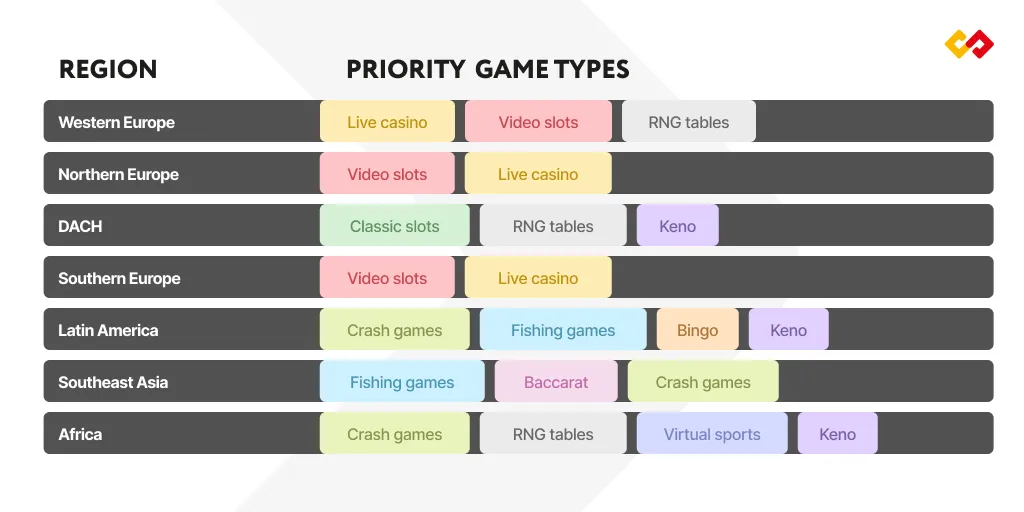
Three-reel, low-complexity titles that replicate physical fruit machines. They serve the purist segment in DACH and Eastern Europe, where land-based nostalgia is a genuine acquisition driver. Studios like Amatic and Amusnet (EGT Interactive) have built catalogues around this format.
Video Slots
Modern five-reel titles with narrative themes, layered bonus features, and buy-bonus functionality are the primary acquisition tool for contemporary demographics in the Nordics, Canada, and Latin America. Pragmatic Play, BGaming, Push Gaming, and Nolimit City operate at volume here, releasing new titles monthly.
Megaways™ Slots
Originated by Big Time Gaming and now licensed widely, they create up to 117,649 ways to win per spin by varying the symbol count on each reel. The extreme variance targets sophisticated high-value players actively seeking risk.
Progressive Slots & Jackpots
Networked titles where a portion of every bet fuels a shared prize pool, often reaching into the millions. Large jackpot figures generate organic acquisition – press coverage, social sharing, player word-of-mouth – at a cost that paid media cannot replicate.
The SOFTSWISS Jackpot Aggregator enables you to offer networked progressive prizes without managing pooled prize structures independently.
RNG Table Games: Drive Player Retention & LTV
In European regulated markets, digital roulette and blackjack together typically account for 10–15% of online casino GGR, though this varies significantly by market and player demographic. With no wait times, lower bet thresholds, and 24/7 availability, they drive session frequency and extend player LTV. Mobile is now the dominant channel across most European markets – accounting for 58% of online gambling revenue across Europe, with Nordic markets already generating over two-thirds of their total gambling revenue online.
RNG table games also solve a practical infrastructure problem: where HD live dealer streaming is not viable – across much of Africa and Latin America – they deliver a full casino experience without bandwidth dependency.
Blackjack
Player decisions (hit, stand, double, split) create a skill layer that drives repeat sessions. With optimal basic strategy, the theoretical house edge can be as low as as low as 0.5% making it one of the most player-friendly RNG formats — though actual outcomes vary based on in-game decisions. NetEnt, Relax Gaming, and Groove Studios.
Roulette
Players place bets on where the ball lands on a digitally simulated spinning wheel. It is a foundational title in any table lobby. Operators can source classics or specific variants fromEvolution (First Person Lightning Roulette),Pragmatic Play (Mega Roulette), andAmusnet (Virtual Vegas Roulette).
Baccarat
Fixed drawing rules, instant results, and strong cultural familiarity in Asian markets make this a high-priority title for operators targeting that segment. Studios: Evolution (Speed Baccarat, Lightning Baccarat, No Commission Baccarat), Pragmatic Play.
Craps
Full digital betting layout with RNG-determined dice results across a complete range of wager types. Studios: Vivo Gaming, Live Solutions.
Live Casino: Where VIP Revenue Concentrates
Live dealer games stream human croupiers to the player's screen, combining the credibility of a physical game with the convenience of online access. The segment is projected to grow at an 11.83% CAGR through 2031 – outpacing the broader casino market – and live/in-play wagering already accounts for 53.4% of all betting activity in 2025. Live casino generated an estimated €3.4 billion in 2025 on a total European online casino market of €25.6 billion.
The core is live Baccarat and Blackjack. The most significant commercial evolution is in live game shows, which compete directly for attention against streaming platforms. Titles like Evolution's Monopoly Live and Funky Time blend high-fidelity AR with real-time human interaction, transforming sessions into a primary entertainment choice rather than a transactional one.
Hybrid games have become a core portfolio requirement for reaching mobile-first and younger players. The 18–24 demographic is recording the strongest growth rate across all age segments in online gambling – estimated at approximately 12% CAGR, while users aged 25-34 already represent 34.1% of the global online gambling customer base. These are the audiences hybrid formats are built to convert.
Crash Games
A multiplier climbs from 1× and crashes at an RNG-determined point – the player decides when to cash out.
Crash games represent approximately 1.1% of European digital casino GGR – around €2.56 billion, but their real growth story is outside Europe. Markets in Africa, Latin America, and Southeast Asia helped push Aviator's monthly players from 42 million to over 77 million in the space of a single year.
Spribe's Aviator and SmartSoft's JetX are the category benchmarks.BGaming and Gamzix offer strong alternatives with proven emerging market performance.
Fishing Games
Players aim and shoot at moving targets to earn multipliers, combining resource management with continuous decision-making. The mechanics sit closer to video gaming than traditional gambling – a deliberate design choice that drives strong performance in Latin America and Asia.
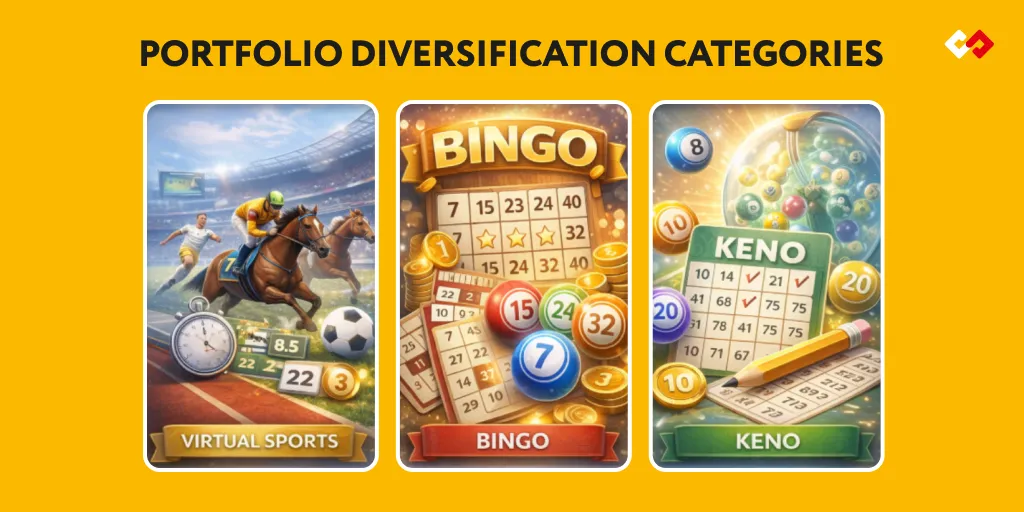
These are RNG-driven simulations of football, horse racing, and cycling running on a continuous schedule. They provide a familiar betting structure without calendar dependency for sports-betting audiences crossing into the online casino and load fast enough to perform in low-bandwidth markets.
Providers such as 1X2gaming and Golden Race offer comprehensive virtual sports portfolios covering football leagues, racing events, and other continuously scheduled simulations.
Bingo
Players mark off called numbers on a card; the first to complete a pattern wins. Bingo is frequently underestimated outside its core markets – but it generates habitual return behaviour through shared draws and community mechanics that slots and table games cannot replicate.
If you are operating in the UK, Nordics, or Latin America, it belongs in your portfolio. Relax Gaming and Amusnetoffer strong regulated-market coverage.
Keno
Players select numbers from a range and win based on how many match the draw. Fast rounds, zero learning curve, and strong cultural familiarity in lottery-oriented markets make it a reliable mobile-first casual format. Studios to consider: SmartSoft Gaming.
How to Choose a Game Provider: an Operator's Checklist
Studio selection is a procurement decision with long-term operational consequences. Evaluate against the following before onboarding any provider:
Game mathematics: Confirm RTPs per title – most regulated markets mandate 92–96% minimums – but also verify variance profile, hit frequency, and math model documentation. These affect player experience and RG compliance in markets like the UK and the Netherlands.
RNG certification: Confirm independent certification from a recognised testing lab – eCOGRA, iTech Labs, or GLI. A prerequisite for regulated market deployment.
Game portfolio and release cadence: Assess coverage across relevant categories – slots, live, crash, table. Release cadence is a useful proxy for a studio's content pipeline health, but it is not the only measure, check as well assess cadence alongside average title performance and IP strength.
Technical reliability: Review uptime SLAs and incident response times. VIP tolerance for downtime is low, particularly in live casino.
Promotional tooling: Confirm support for free rounds, prize drops, and tournaments – and whether these can be triggered from your platform or require studio-side configuration.
Analytics and reporting: Confirm availability of game-level performance data – session length, hit frequency in practice, volatility distribution – to support placement and promotional decisions.
Exclusivity and content windows: Early-access or exclusive titles carry direct acquisition value and should factor into commercial negotiations.
Localisation: Verify language support, currency compatibility, and regional themes. A baseline requirement for LatAm, Southeast Asia, and Africa.
A well-structured game portfolio should be measurable at the category level. The following KPIs provide a category-level view of whether your lobby is working.
GGR per active title: Set category-level thresholds and remove underperforming titles on a rolling basis. Flag any title generating materially less than its fair share of category GGR – its expected contribution if play were distributed evenly across the category – after 60–90 days of active placement. Measure against theoretical GGR (turnover × house edge) rather than raw GGR to account for RTP differences between titles.
Category-level LTV: Track by game category, not just overall. Internal data from some operators suggests crash game players may generate significantly higher LTV than slot players – with multipliers of 3× or more reported anecdotally – though this varies materially by operator type, player demographic, and market. Operators should track this metric independently within their own platform before weighting their lobby accordingly.
Lobby-to-play conversion rate: Low conversion typically points to poor architecture or content imbalance, not an acquisition problem.
Cross-category play rate: Higher cross-category engagement correlates with longer retention and higher LTV. Operators who actively cross-promote between live casino, slots, and crash formats report higher session frequency and stronger retention metrics than those with a single dominant category.
Reactivation response by format: Track which formats drive the highest return rates in reactivation campaigns. Instant-win and crash games frequently outperform slots in this context.
Responsible Gambling: the Operator’s Standard
In 2026, responsible gambling is a core operational requirement. Operators must build player protection directly into the product, not layer it on after the fact:
Transparent game information – clear RTP displays on all titles.
Spend controls – deposit limits and session timers are accessible by default.
Behavioural safeguards – bonus mechanics audited for loss-chasing incentives and support teams trained to recognise early risk signals.
Building a high-performance casino lobby is about offering the right things, in the right proportions, for the right audiences. The 40/40/20 model gives you a proven framework to start from. The game types covered in this guide give you the building blocks to execute it. What ties it all together is having the right aggregation infrastructure in place – one that gives you certified content at scale, unified reporting, and the flexibility to move as markets evolve.
What are gambling games?
Gambling games are structured activities in which players wager money on an uncertain outcome – determined by chance, skill, or a combination of both.
What game categories should an online casino operator offer?
The primary categories are slot machine games (classic, video, progressive), table games (roulette, craps, baccarat), card games (blackjack, poker variations), live dealer games, crash and instant-win titles, and virtual sports. Online casinos combine all of these within a single lobby architecture.
What is a game aggregator, and how does it work?
A game aggregator provides a single API connection that gives operators instant access to thousands of certified titles from multiple studios, eliminating the need to integrate each provider individually. The SOFTSWISS Game Aggregator is an example of this infrastructure model.
Which casino game types perform best on mobile?
Crash games, arcade titles (Mines, Plinko), instant-win formats, and classic slots are natively suited to mobile – fast rounds, minimal interface, and intuitive controls. Live dealer content requires stable bandwidth and performs better on mid-to-high-end devices. For low-bandwidth markets across Africa and parts of Latin America, RNG table games are the reliable mobile alternative to HD streaming.
What RTP should operators look for when selecting slots?
Regulatory RTP minimums vary significantly by jurisdiction. The UK Gambling Commission sets a floor of 70%, while many other regulated markets, including Malta, rely on certification standards rather than fixed RTP floors. In practice, video slots published in competitive regulated markets typically display RTPs in the 94–97% range, reflecting player expectation rather than a universal legal requirement. Progressive jackpot titles commonly carry lower base RTPs of 88–94%, as a portion of every wager funds the shared prize pool.