Launching an online casino in the UK requires a UKGC Remote Casino Operating Licence and compliance with LCCP and RTS frameworks.
UK players cannot use credit cards for gambling. The payment stack runs on debit cards, e-wallets and bank transfers instead.
Age verification, GAMSTOP self-exclusion, financial limits and behavioural monitoring all need to be live before the first real-money bet lands.
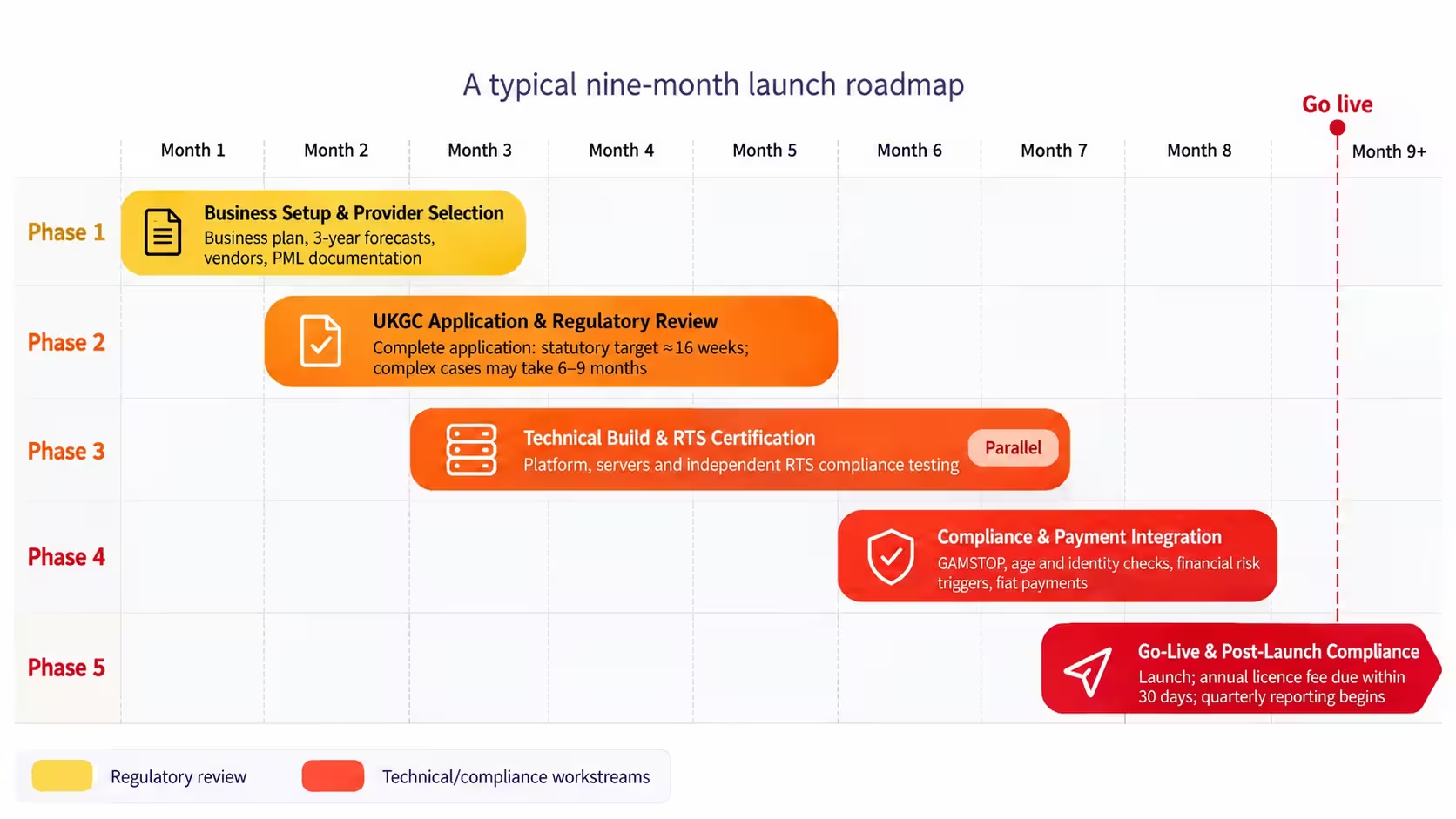
A UKGC licence application typically takes 16 weeks, while the overall launch process can take 9-18 months.
Total capital required for launch through Year 1 operations ranges from £645,000 to £2,300,000+ (€750,000–€2,680,000+), spanning pre-launch regulatory prep, tech platform infrastructure, operational reserves, and initial player acquisition.
This guide outlines a step-by-step roadmap for launching an online casino in Great Britain, covering England, Scotland and Wales. Northern Ireland sits under separate gambling legislation. "UK" shows up elsewhere in this piece only as the common shorthand for the market.
Market Size and Competitive Landscape
Great Britain’s online gambling market, regulated by the UK Gambling Commission (UKGC), is the largest in Europe, generating over 25% of the continent's total digital gambling revenue in 2026.
The online casino vertical drives most of this commercial momentum. UKGC'sfigures for Q3 2025/26 place its Gross Gambling Yield (GGY) – the regulator's metric for gross gaming revenue (GGR) – at £1.5 billion (roughly €1.75 billion), which stands for 70% of the remote gambling total.
That yield is generated across more than 1,100 active domains listed on theUKGC Public Register, operated by between 170 and 200 corporate licence holders. The market is concentrated: a small group of major operators accounts for more than 60% of revenue, while established challenger brands take roughly a quarter.
Breaking into this landscape means absorbing steep statutory costs and heavy regulatory burdens from day one, while skipping generic mass-market positioning in favour of sharp, targeted differentiation.
UKGC Online Casino Licensing Framework
The Gambling Act 2005 provides the main legal framework for gambling, while the Gambling Commission’s Licence Conditions and Codes of Practice (LCCP) sets the binding statutory criteria for corporate authorisation. Depending on the operational architecture and product scope, launching a compliant remote casino requires securing specific operating, software, and key management licences:
Remote Casino Operating Licence: The primary B2C licence. It authorises operators to offer online slots, table games and games of chance to players in Great Britain.
Ancillary Remote Licences: Additional operating licences required if the casino platform integrates other verticals, such as sports betting or online bingo.
Remote Gambling Software Licence: This B2B licence is only required if your operation builds, adapts, or hosts proprietary gambling software in-house. Operators utilising third-party turnkey platforms or external game aggregators are exempt from holding this themselves. However, as the B2C licensee, you are legally obligated to verify that your every technology partner holds a valid UKGC software licence.
Remote Casino (Game Host) Licence: Required if the operator hosts gaming software on its own servers that players access via third-party operator platforms.
Personal Management Licence (PML): Senior staff in key operational roles need individual authorisation. Officers overseeing strategy, compliance, finance, IT/cybersecurity and marketing must each hold a valid PML from the UKGC.
Operating without the required licence is a criminal offence. It can also prevent a business from working with established game studios, payment providers and marketing partners.
1. Obtain a Remote Casino Operating Licence
Any business anywhere in the world can apply for a UK Gambling Commission (UKGC) licence to launch an online casino in Great Britain, regardless of where the company is incorporated. It just need to hold an official UK correspondence address and clear the regulator's suitability standards:
Full disclosure of corporate ownership structures and ultimate beneficial owners.
Clear capital trail, verified source of funds, and viable three-year financial projections.
Clean criminal record checks for all corporate entities, directors, and key stakeholders.
Demonstrated industry experience and technical capacity to operate a remote gambling platform.
Licence Fees, Tax and Statutory Levies
UKGC operating-licence fees are linked to annual GGY bands. Each band sets three costs: a non-refundable application fee for background checks, a first-year annual fee, and an ongoing full annual fee from year two on.
UKGC Licence Fees
Fee Category
GGY Band
Application Fee*
First-Year Annual Fee** (-25%)
Ongoing Annual Fee
Cat F1
Under £250,000 (≈€290k)
£8,185 (≈€9,580)
£5,250 (≈€6,140)
£7,000 (≈ €8,190)
Cat G1
£3m – £10.5m (≈€3.5m – €12.3m)
£40,475 (≈€47,356)
£20,503 (≈€24,000)
£27,337 (≈€32,000)
Cat J1
Over £1.6 billion (≈€1.9bn)
£165,069 (≈€193,130)
£1,090,462 (≈€1.28m)
£1,453,949+ (≈€1.70m+)
The initial fee category is based on the applicant’s business plan. The discounted first annual fee is payable within 30 days of the licence being issued; later annual fees are due before each licence anniversary.
Tool
Online Casino Budget Calculator
Enhance your chances of a successful launch by downloading a free launch and operational cost analysis tool. It's a key to a strategic and impactful start.
Other Regulatory Costs and Taxes
The cost of entering the market changed significantly in 2025 and 2026. Thestatutory gambling levy took effect in April 2025, the remote gaming duty increased from 21% to 40% from 1 April 2026, and newUKGC licence-fee bands apply from 1 October 2026.
Cost item
Approximate figure
Frequency
Personal Management Licence (per senior role)
£370, rising to £463 from Oct 2026 (approx. €433–€542)
Per licence
Remote Gaming Duty
40% of taxable remote-gaming profits from UK customers
Ongoing, on profit
Statutory gambling levy
1.1% of GGY (remote casino band)
Annual
2. Choose a Software Provider
A software provider has a direct effect on the operator’s compliance workload and day-to-day risk. When comparing vendors, assess the following areas:
ISO/IEC 27001 certification for Information Security Management Systems (ISMS), covering data security, database management, and hosting infrastructure.
Real-time database KYC checks (name, DOB, address) executing prior to deposit or play, supported by automated secondary document upload flows.
Native API connectivity to Great Britain's mandatory national self-exclusion database GAMSTOP.
Hard-coded stake limits restricting online slot wagers to £2 (~€2.35) per spin for players aged 18–24 and £5 (~€5.85) per spin for players aged 25 and older.
Dynamic player limits (deposit, loss, time) backed by mandatory cooling-off periods, alongside backend telemetry tracking play velocity and session duration to trigger automated customer interventions.
Content Portfolio & Regulatory Adaptability
Access to major game studios supplying ready-to-deploy, UK-certified titles.
Vendor commitment to updating backend logic in line with evolving LCCP rules without requiring platform rebuilds or service interruptions.
Infrastructure & Service Level Agreements (SLAs)
Contractually guaranteed 99.99%+ uptime backed by financial credits, high-concurrency transaction handling, and geo-redundant server architecture to maintain sub-second responsiveness during peak traffic.
3. Align Game Content With Target Audience
UKGC data (2025–2026) confirms online slots drive Great Britain's remote casino market, generating £4.8 billion (≈ €5.6 billion) – or 84% – of the total £5.7 billion (≈ €6.6 billion) GGY. Table games and live dealer make up the remaining 16% (~£900 million / ≈ €1.04 billion).
Mass-Market Casuals: Gender-balanced casual players seeking low-stake (£2–£5 / ≈ €2.30–€5.80 caps), low-friction entertainment. Lobby Focus: Stock a broad selection of slots, including Megaways, hold-and-win titles, and progressive jackpots.
High-Intent VIPs: High-earning, predominantly male players seeking strategy and live-dealer setups (Blackjack, Roulette). Lobby Focus: Provide ultra-reliable live streams, a robust suite of table games, custom betting limits, and tailored account management.
On-the-Go Mobile Players: Digital natives playing short micro-sessions during commutes or multitasking routines. Lobby Focus: Prioritise a lightweight, mobile-optimised UX built for 70%+ of smartphone traffic.
4. Select Payments for UK Players
Payment infrastructure must strictly align with UKGC regulations, which have banned credit cards for gambling since April 2020. While GBP debit cards remain the primary checkout method (~73% share), bank-level gambling blocks frequently trigger deposit declines. To maintain conversion rates, operators rely on Open Banking via Faster Payments alongside high-adoption e-wallets like Apple Pay (63% UK usage), Google Pay, and PayPal.
Technical processing architecture must also meet the exact UK card-scheme standards. Payment service providers must process all transactions in GBP and correctly assign Merchant Category Code (MCC) 7995. Miscoded transactions face immediate, automated hard declines from UK card issuers, making proper MCC coding essential to preventing lost deposits regardless of an operator's UKGC licence status.
What About Crypto?
While the UKGC does not explicitly ban cryptocurrency, using it creates additional regulatory and operational hurdles.Operators capitalised by crypto profits must pass rigorous upfront source-of-funds verification during the licensing process.
Furthermore, accepting crypto deposits requires notifying the UKGC as a "key event" and passing an enhanced AML risk assessment covering price volatility, insolvency, and consumer protection – a bar so high that no mainstream UKGC operator currently accepts crypto.
5. Enforce Advertising Compliance and Affiliate Oversight
Compliance has to be built right into the daily marketing workflow at all levels. Before a campaign launches, every asset must clear a strict audit – against the CAP Code for digital and print, and the BCAP Code for TV and radio. The aim is to ensure that promotional terms, opt-in rules, and age limits are completely transparent.
Casting requires just as much caution due to mandatory age verification. The UK enforces a hard under-25 restriction: anyone who is, or even looks, under 25 is banned from featuring in gambling ads. This effectively rules out young athletes, social media influencers, and trending public figures.
For direct player acquisition, operators rely heavily on Google-certified search marketing – combining PPC and gambling SEO – to capture high-intent traffic actively looking to deposit.
In parallel, affiliate marketing remains the highest-converting performance channel in the UK, delivering immediate scale without upfront media risk through CPA, revenue-share, or hybrid models. However, this channel comes with a critical compliance catch: because the UKGC holds operators 100% legally liable for third-party marketing, real-time affiliate monitoring and strict contractual oversight are mandatory to avoid severe enforcement actions.
6. Deploy Compliant Customer Support
Customer support functions as a statutory player-protection barrier. Support teams must actively monitor channels for distress signals or rapid deposit velocity, executing immediate account holds when acute risk appears.
For customer disputes, operators must resolve complaints within eight weeks or provide access to a free, UKGC-approved Alternative Dispute Resolution (ADR) entity like IBAS. Front-line staff require continuous, documented training in social responsibility, vulnerability, and AML protocols, backed by regular compliance QA audits.
Launch Process and Timeline
The Commission'sown published figure for processing a complete application is 16 weeks – assessment only, not preparation, technical build or pre-launch testing. Factor those in, and the full route from planning to launch typically stretches to 9–18 months.
Ongoing Compliance Obligations
Operators must submit quarterly and annual returns through theUKGC eServices Portal, detailing GGY, active player counts, self-exclusion logs, customer interaction triggers, AML red flags, and dispute metrics.
Concurrently, operators must fulfil dual tax obligations: declaring Remote Gaming Duty toHM Revenue & Customs at 40% of net gaming profits while remitting an annual statutory levy of 1.1% of GGY directly into national research, prevention, and treatment funds.
Budget Requirements
Total Cost Estimates
Cost item
Approximate figure
Frequency
Regulatory, legal and compliance preparation
£65,000–£250,000 (≈ €75,000–€290,000)
One-off/pre-launch
Platform, games, payments and compliance tools
£180,000–£750,000 (≈ €210,000–€875,000)
Initial setup and ongoing
Staff, operations, working capital and reserves
£300,000–£800,000 (≈ €350,000–€930,000)
Ongoing
Initial marketing and customer acquisition
£100,000–£500,000+ (≈ €115,000–€585,000+)
Initial launch phase
Total Estimated Launch & Year 1 Capital
£645,000–£2,300,000+ (≈ €750,000–€2,680,000+)
Initial setup through Year 1
A managed or partner-led launch of an online casino typically requires £500,000–£1 million (≈ €585,000–€1.17 million). A more independent operation may require £1 million–£2 million or more (approximately €1.17–€2.33 million+) before tax liabilities.
Conclusion
Starting an online casino in the UK is one integrated undertaking – licensing, compliance and product design, all running through the UKGC's Remote Casino Operating Licence, the LCCP and the RTS. None of it works in isolation.
Entry economics are tight, tax rates are rising, and the technical bar is high. Getting through it takes real strategic planning and the right market partners. As a global iGaming technology partner, SOFTSWISS delivers expert analysis and market insight to help operators read the regulatory shifts and weigh commercial opportunities across international jurisdictions.