What is iGaming? The Meaning and Evolution of Online Betting
What is iGaming? The Meaning and Evolution of Online Betting
Updated: June 1, 2026
Online slots and sports betting have long been popular pastimes in many countries, and the digital age has brought them to screens everywhere. This fusion of technology and recreation is known as iGaming, an industry that places the casino in the player’s pocket, available whenever and wherever they choose. Our analysis explores its origins, its key players and the trends shaping the future of entertainment.
What Does iGaming Mean
iGaming refers to online betting and gaming activities that use internet technology, most narrowly the wagering on games of chance through electronic means. The ‘i’ stands for internet. In a broader sense, the term describes an industry spanning multiple online verticals, from casinos, sports betting and sweepstakes to lotteries, bingo and card games, along with the companies that serve them. Game developers, such as those producing software for online casinos, and gambling software platform developers, such asSOFTSWISS, are both part of this wider market.
Games of chance, whose outcomes depend largely on random number generators or luck, are distinct from games of skill, where the result turns more on the player’s mental ability. Online casinos, sports betting, sweepstakes, lotteries, bingo, fantasy sports and eSports fall into the first category, while poker, blackjack, bridge, chess and backgammon belong to the second. The industry has yet to agree on whether games of skill belong within the broader definition, andiGaming events reflect both views.
RNG explained: Build trust and transparency, and enhance your player experience.
How iGaming Started
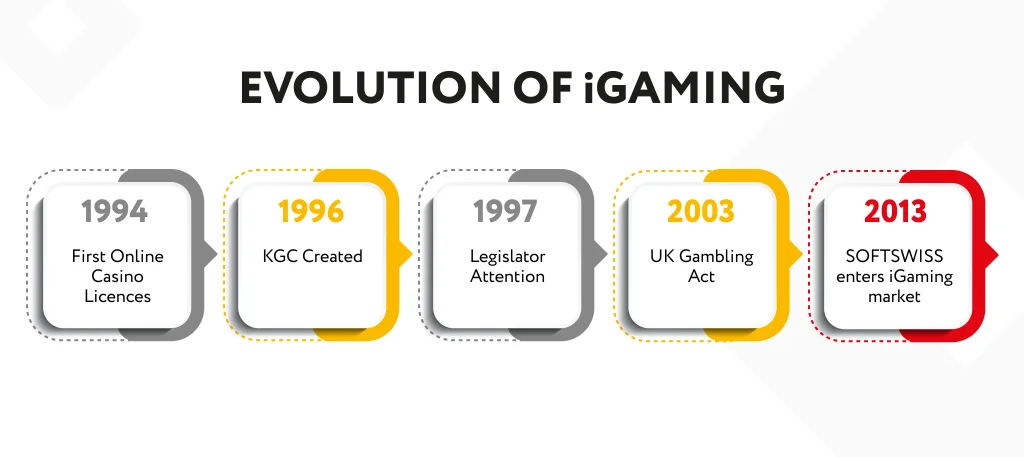
The iGaming sector grew rapidly alongside urbanisation, technological progress and the spread of the internet. Its roots reach back to 1994, when Antigua and Barbuda created a licensing framework for online casinos, and 1996, when the Kahnawake Gaming Commission began licensing operators worldwide. Regulation followed in the late 1990s and 2000s, with the United Kingdom’s Gambling Act of 2005 establishing the Gambling Commission and allowing gambling sites to operate legally. SOFTSWISS entered the market in 2013 with itsOnline Casino Platform.
Who is Who in IGaming?
It is easy to mix up the terms that are used to describe the key actors of the iGaming industry. Below we provide a short classification of the most crucial terms used to refer to the key players in the industry.
iGaming Operator
iGaming operator – a person in charge of an iGaming business, who runs daily operations and marketing, offering online wagering to end users.
iGaming Supplier (Vendor)
iGaming supplier or vendor – a company that develops and sells the software (platform, games, odds, etc.) to operators who then use it to power their online brands. These are most often referred to as B2B iGaming software suppliers, also commonly known as B2B providers (not to be mixed up with game providers).
Game Providers
Game provider – also called a game studio, a company that develops the interactive video game content that is added to online casinos. These arevideo slots, card games, crash games, and other genres of RNG and live dealer game content.
Players
Player – the end user (customer) of an operator's site (online casino orsportsbook). Players make bets in the games developed by game providers that are hosted on the operator's website.
Affiliates
Affiliate – webmasters and site owners who host promotional materials that encourage players to register and play at online gambling sites. Affiliates receive a commission based on the performance of the players they help the operator acquire.
iGaming Regulation Worldwide
Online gambling is regulated at the national or regional level, so the same activity can be permitted in one market and banned in another. Markets generally fall into three categories:
Licensed markets: Online gambling is legal and regulated by the state. Operators need a local licence to serve players in the country, much as land-based operators do. Examples include Bulgaria, the Czech Republic, Estonia, Germany, Greece, Latvia, Romania, Sweden, and the Netherlands. Some regimes are stricter still. In Lithuania, for instance, operators must hold a set number of active land-based venues before they can run an online site.
Prohibited markets: Online gambling is banned outright, as in Israel.
Unregulated markets: Online gambling is neither explicitly permitted nor prohibited, so operators work in a legal grey area.
Licensed markets typically impose a common set of requirements on operators:
Licensing: Operators must hold a valid licence from the relevant regulator.
KYC and AML: Operators verify player identities and monitor transactions to prevent money laundering.
RNG certification: Independent testing confirms that random number generators are fair.
Responsible gambling: Operators provide safeguards such as deposit limits and self-exclusion.
Taxation: Operators pay gaming taxes or duties on their revenue.
Advertising rules: Restrictions govern how and where operators can promote their services.
Because rules change frequently, the current position in each country should be checked before entering a market. The Gambling Regulation Map provides an up-to-date country-by-country overview.
Report
2027 iGaming Trends
Unlock the future of iGaming with our trends report. Discover the industry's latest developments and upcoming opportunities for success.
Prospects of the iGaming Industry
There are more and more technologies that influence the promising growth of the online gambling market in the near future. Let’s take a closer look at each one.
Blockchain Technology
Blockchain technology transforms iGaming operations in three ways: it records game results so they cannot be altered; it enables direct, intermediary-free transactions; it allows users to register without sharing their personal information.
There are two types of online casinos that use blockchain technology:
Crypto casinos. These integrate cryptocurrency payment systems toaccept cryptocurrencies such as Ethereum (ETH), Litecoin (LTC), andBitcoin (BTC), on par with fiat currencies for deposits and withdrawals.
Blockchain-based casinos. These are built directly on the blockchain. Transactions are handled without intermediaries, moving directly between the player’s crypto wallet and the blockchain via the game.
Key advantages of using blockchain technology in the online gambling industry include:
Speed. Withdrawals are processed almost instantly without delays to start betting.
Lower costs. iGaming operators working with cryptocurrencies offer the lowest commissions for depositing and withdrawing funds due to the lack of intermediaries and the decentralisation of transactions.
Privacy. No personal data is needed from players when opening an account, eliminating security risks.
Streaming and Social Media
Streaming gives users the opportunity to watch their favourite streamer wager in real time and live the highlights of the game with them. Streamers also try to make the broadcast spectacular, so they choose slots with frequent bonuses and generous payouts and do not skimp on emotions during the broadcast.
All this attracts user traffic to the online casino or sportsbook, especially if the given operator and the specific streamer are partners. The streamer places on their webpage useful information for players, for example, operator rating indicators, interspersed with banners and links to the partner casino site.
Not every streaming platform encourages gambling ads. For example, in 2021 clips and broadcasts on the Twitch platform that featured promotional codes and referral links to gambling sites were banned. The platform ordered streamers to remove such content. However, casino streaming is not entirely gone from Twitch. Other streaming platforms dedicated to online casinos and sports betting, like Kick, are also on the rise.
Gamification
To attract a young audience and maintain the level of interest in the game,online casinos add elements ofgamification to the gameplay. Gamification is the addition of additional engagement and loyalty opportunities inherent to the video game industry. This can include character selection, quests, level rewards, and much more.
Gamification allows an operator to increaseplayer retention rates through player motivation. Depending on the choice of mechanics or gamification tool, the operator satisfies the different needs of the players:
Tournaments give a player the opportunity to compete and become the first among others. The most successful gamblers are displayed on the leaderboard and receive a variety of bonuses from the online casino.
Character selection allows the player to add personal preferences to the game, which affects their involvement and interest in the gameplay.
Quests are fun and interesting missions that become more challenging from level to level. For the successful completion of quests, the player receives a prize, maintaining satisfaction and the desire to continue the game.
Game Graphics and 5G
Currently, HTML5 is widely used to create slot games. HTML5 slots offer players fast-loading low-size games that work across all platforms. However, HTML5 is not the only engine that is used to develop slot games. More and more attention is paid to Unity, a game engine for developing 3D game content popular across mobile gaming and desktop gaming at large.
Download speeds directly affect game loading times. The solution comes in the form of 5G technology. Though this is something largely outside the scope of an iGaming operator and more in the hands of players, 5G is one way to make your casino or sports betting experience much smoother as a player.
iGaming is an Industry
Many factors have influenced the development of iGaming, including the COVID-19 pandemic, forced lockdowns, advances in mobile technology and handheld devices, and the rise of live streaming platforms.
The iGaming sector draws professionals with backgrounds in computer science, mathematics, and game design. It's not uncommon to see executives who have worked with big brands, from Coca-Cola to Netflix.
iGaming is not just an online copy of the brick-and-mortar brands, though there are examples of thisshift to online by big-name offline brands. The iGaming industry is constantly developing on par with information, blockchain, and mobile technology. If any of these sound familiar to you then you are likely to have brushed against iGaming at one point or another.