

Knowledge Base
Filipa Teles
9 Steps to Grow Your Online Sportsbook in 2026
View Details
June 16, 2026

The global sports betting industry is expanding at a pace that leaves little room for operators who treat marketing as an afterthought. With a projected global market volume of €99.56bn by 2030, the imperative to implement effective, data-driven marketing strategies has become a defining factor for sustained profitability.
As new jurisdictions legalise online wagering and established markets become more crowded, sportsbook operators can no longer rely on welcome bonuses and brand visibility alone. Revenue is being won and lost on the quality of marketing decisions, not just on the size of the marketing budget.
Sustainable growth in iGaming demands a strategic, multi-channel approach: one that combines acquisition efficiency, localised engagement, data-driven personalisation, and a compliance framework that keeps every campaign on the right side of the law. This article covers eight proven sports betting marketing strategies to effectively support a successful sports betting business.
Sports betting has evolved into a mature iGaming and wagering industry where marketing spend, acquisition cost, customer lifetime value, and profit must be managed together.
To put the scale of competition into perspective, in 2025, operators in the US alone spent $3.9 billion in marketing. Yet, the operators that grow efficiently are not always the ones with the largest budget. They are the ones who know which channels attract high-value players, which messages motivate, and which retention tactics keep customers active after the first deposit.
Competing purely on deposit bonuses compresses margins and attracts bettors with low long-term value. The smarter approach focuses on:
The solution is not to spend more – it is to invest differently. To grow their sportsbook, operators must move from a “more traffic” mindset to a “better-quality traffic, stronger retention, and measurable profitability” framework.
Regulatory compliance is the operating system behind every sports betting marketing strategy. Before launching any campaign, operators need to understand the regulations, legislation, and jurisdiction-specific rules that govern advertising, promotions, data handling, and player communication.
This is especially important in fragmented markets. In the US, for instance, sports betting is shaped by state-by-state regulations, which means a campaign that works in one state may be restricted or unavailable in another. Operators need geopositioning and geolocation controls to ensure offers, landing pages, and media placements are only shown where and how they are legally permitted.
Data privacy is equally important. GDPR requires operators targeting EU users to treat personal data with care, by including opt-in communications, transparent consent, and clear information privacy practices.
Before campaigns go live, operators should check:
Compliance should not slow marketing down. Instead, good governance, campaign audit trails, and player protection policies help operators move faster because every team understands the rules from the start. Besides, these steps help build brands that regulators trust and bettors feel safe using.
Marketing localisation is a game-changer when it comes to effective sports betting marketing. It means adapting campaigns, language, offers, sports coverage, and compliance messaging to each market’s legal, cultural, and commercial reality.
A localised sportsbook does more than translate banners. It uses market segmentation to understand which sports matter, which betting formats are familiar, which payment methods are trusted, and which messages feel relevant. Football may dominate acquisition campaigns in many European and Latin American markets, while basketball, baseball, cricket, esports, or regional tournaments may matter more in South Asian or African markets.
Localisation also improves customer engagement. When bettors see local language, familiar sports references, culturally relevant promotions, and community-specific content, the customer experience feels more personal. That fosters a sense of belonging and trust, especially in markets where regulated sportsbooks compete with unregulated alternatives.
As multi-jurisdiction marketing requires localised assets, geo-specific bonus rules, regional content calendars, and legal review workflows, a strong content strategy helps operators manage such complexity by defining what can be reused globally and what must be adapted locally.
A practical first step is to build a localisation matrix for each target market before creative production begins:
Content marketing and SEO are interconnected organic acquisition pillars – and they work best when treated as a single system. Content builds trust and authority with potential bettors; SEO ensures that content is discoverable at the moment of intent. Together, they form a cost-efficient, scalable acquisition engine that compounds in value over time, unlike paid channels that stop delivering the moment spend stops.
High-performing sportsbook content usually combines education, entertainment, and expert insights. Different formats serve different stages of the bettor journey:
The shift toward owned media channels – where the sportsbook itself becomes a destination for sports entertainment, not just a place to place bets – is becoming an increasingly safer option: owned media matters because platform rules can change quickly, and sportsbooks that depend only on third-party platforms are exposed when those rules shift.
YouTube, for example, tightened online gambling content policies in 2025, including restrictions on mentioning or displaying logos of certain non-approved gambling services.
Pro Tip: build a content calendar around the sports calendar, then mix timely match content with evergreen education.
SEO for sportsbook growth rests on three main pillars: on-page SEO, technical SEO, and backlink strategy.
On-page optimisation covers keyword strategy, content development, and metadata structure adjustments. These elements ensure every page clearly signals its relevance to Google and other search engines, as well as to AI-powered answer engines, increasing its click-through rate (CTR). Technical SEO addresses site architecture, crawlability, page speed, and indexing quality, which determines whether the sportsbook’s content can rank at all. Finally, strategic backlink building from authoritative sports, news, and iGaming domains provides the trust signals that move rankings in search engine results pages.
For operators, implementing SEO best practices for sportsbook promotion is attractive because organic search can bring high-intent users at a lower marginal cost than paid acquisition. It also supports customer lifetime value: a player who finds a useful guide and returns for previews may be more engaged than someone acquired through a one-off bonus ad.
The key is time and patience. SEO rarely delivers overnight results, but it can become one of the most efficient sports betting marketing channels when content quality, technical performance, and authority grow together.
Paid advertising gives sportsbook operators reach, speed, and control. The channel mix can include Google Ads, display ads, paid social, where permitted, programmatic advertising, and over-the-top (OTT) media service placements. Each format has a different role in the funnel.
Search campaigns capture active demand: users looking for odds, betting apps, or event-specific promotions. Display ads and programmatic advertising create awareness and retarget users who have already interacted with the brand. Programmatic campaigns use real-time bidding to buy impressions across digital inventory, often on a cost per mille basis. That can be more flexible than traditional TV because audience segmentation, behavioural retargeting, and mid-flight optimisation are built into the process.
OTT advertising is especially relevant for sports betting marketing because it can connect offers to live match viewing contexts. For example, an operator might promote an in-play feature around a major fixture, provided the campaign respects advertising restrictions, geolocation rules, and responsible gambling standards.
Another advantage is ease of measurement. Real-time monitoring lets teams track each performance indicator – impressions, click-through rate, registrations, deposits, and cost per acquisition – then refresh creatives or shift budget quickly. The main risk is ad fatigue. Sportsbook audiences see many similar offers, so operators need regular creative testing, precise targeting, and compliant message variation to keep their campaigns successful.
Social media serves a dual function for sportsbook operators: it amplifies marketing reach and it delivers real-time customer support. These two roles require different content strategies and operational layouts, but they share the same underlying objective: building a community that feels a sense of belonging with the brand.
Some platform-specific tactics for sports betting marketing may include the following:
Besides generating word-of-mouth promotion, social communities also connect well with gamification initiatives: predictions, leaderboards, missions, and non-monetary achievements can create emotion and participation without relying only on bonuses.
The main challenge for sports betting social media marketing revolves around content restrictions. The major platforms impose different levels of restriction on gambling advertising, and compliance varies by jurisdiction.
Pro Tip: The most effective social strategies for sports betting adapt to where fans are already consuming sports information, rather than trying to import them into unfamiliar formats.

Strengthen your offering with scalable sportsbook software designed to support ambitious operators.
Influencer marketing in sports betting operates across two distinct tiers – and understanding the difference determines whether the investment generates brand awareness or community trust.
Celebrity ambassadors and athlete endorsements offer reach and credibility at scale: a recognised sports analyst or former player carries the kind of authority no display banner can replicate, but the trade-offs are real: high cost, limited targeting precision, and reputation risk in case of controversy involving the ambassador.
Micro-influencers work differently. A content creator covering a specific football league may have a fraction of the audience, but their followers are engaged and more likely to follow their recommendations. Authenticity is higher, the cost per engagement is lower, and the connection to a real community is easier to measure.
The decision depends on the goal: celebrity campaigns are useful to promote brand awareness. Micro-influencers help with establishing credibility, regional acquisition, and community proximity. In both cases, contracts should include compliance messaging, content approval rights, disclosure requirements, and clear rules on prohibited claims.
Attribution is also important: as much as influencer campaigns use tracked links, promo codes, landing pages, and post-campaign analysis, operators must accept that some value appears as assisted awareness rather than direct deposit-level return on investment (ROI).
Affiliate marketing is a performance-based acquisition tool. Third parties – review sites, comparison portals, tipster communities, and content creators – promote the sportsbook to their audiences and earn a commission only when a qualifying conversion occurs. That cost-per-action (CPA) or revenue-share model ties spend directly to outcomes, making affiliate programmes one of the most margin-efficient lead generation channels available to operators.
However, affiliate programmes require governance. Misleading claims, outdated bonus terms, poor disclosure, or aggressive messaging can create regulatory compliance issues for the operator, even when the content is published by a third party.
Quality control is also essential because fraud risk can include false leads, duplicate accounts, incentive abuse, and traffic from restricted jurisdictions.
Best practices for managing a sports betting affiliate programme include:
Fraud is a real risk at scale: artificially inflated clicks and registrations, and cookie-stuffing are known tactics in affiliate networks. A robust affiliate management software, along with strong contractual terms and a governance framework for audit and quality control, are prerequisites for any successful affiliate programme.
Email marketing and personalisation should be regarded as two sides of the same coin, as modern bettors expect communications that reflect their actual behaviour and preferences.
The goal is to create a better customer experience by sending the right message at the right time, through the right channel, and with a clear reason to act.
Email segmentation divides the player base by betting behaviour, sport preferences, activity level, and demographics, enabling tailored flows for each segment. A bettor who wagers on football every weekend, for instance, will have different needs from a casual player who last deposited three months ago.
Effective segmentation translates into:
Automation provides real-time responsiveness with no manual intervention required when a player qualifies for a segment trigger. GDPR-compliant opt-in management and frequency capping are non-negotiables: too many emails lead to deliverability drops, and too few emails make the sportsbook invisible.
Rule of thumb: every email should answer one question from the bettor’s perspective – “Why am I receiving this now?”
Artificial intelligence moves personalisation from manual segmentation to predictive, real-time decision-making. Machine learning models can analyse player behaviour tracking data, identify preferences, and power a recommender system for tailored promotions, customised bonuses, and relevant betting suggestions.
A typical AI personalisation pipeline looks like this:
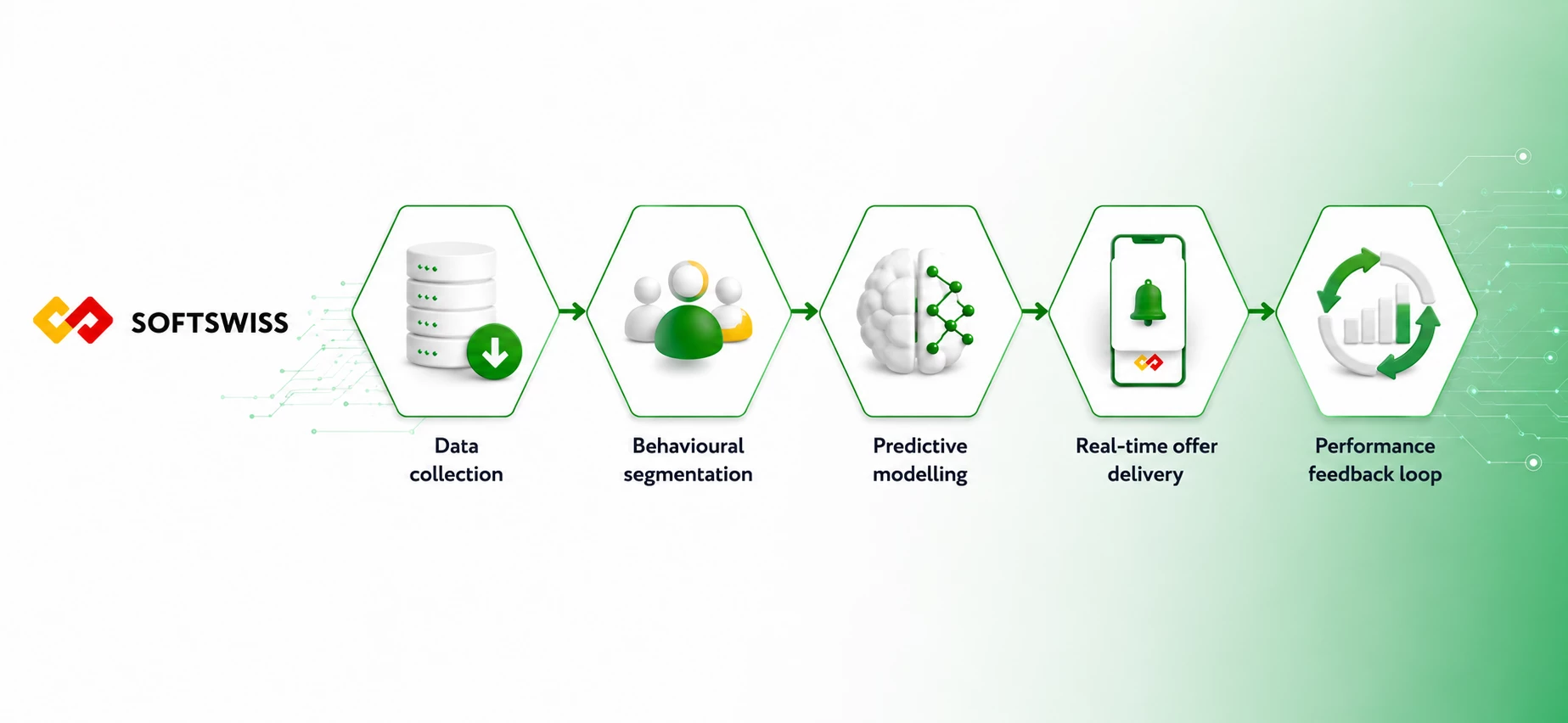
The values provided are speed, accuracy and precision. Algorithms can detect when a player is more likely to respond to an in-play offer, when a bonus may be unnecessary, or when a responsible gambling intervention may be more appropriate than a promotion. Predictive analytics and real-time insights also improve efficiency as campaigns become more targeted.
However, hyper-personalisation needs guardrails. Operators must balance relevance with data protection obligations, avoid exploitative targeting, and ensure automation supports player protection. AI should improve the customer experience, not pressure vulnerable users.
A good loyalty program turns short-term betting activity into longer-term brand trust. The most effective programmes use a reward system that recognises different types of players, and its structure matters more than most give it credit for.
At the entry level, welcome bonuses, deposit matches, and free bets help new players try the sportsbook. Ongoing promotions can keep recreational users active around key events. Referral rewards encourage word of mouth by giving existing players an incentive to invite friends. VIP programmes and high-roller tiers then add personal account management, faster withdrawals, customised bonuses, exclusive events, gift card rewards, and premium customer service.
A practical tier structure might look like this:
As previously mentioned, a strong loyalty programme is a structured way to protect customer lifetime value (LTV) as it allows upselling and cross-selling opportunities where permitted.
Addressing bonus hunters is the main challenge at this stage, as these are players who take every offer without generating meaningful revenue. Identifying future VIP candidates early through betting patterns, session frequency, and NGR contribution lets operators direct their resources towards players that are more likely to stay.
Without measurement, operators cannot tell whether sports betting marketing is creating profit or just increasing activity. Analytics connects all eight strategies by providing the information needed to make informed decisions: spend toward what works, catch underperforming channels early, and build a feedback loop that improves performance over time.
This feedback loop – measure, adjust, iterate – is what turns data into continued improvement: measuring the key performance indicators (KPIs) leads to adjustments in tactics. By iterating on these changes, operators can consistently improve their performance and outcomes over time.
SOFTSWISS' guide to sportsbook KPIs covers the full framework in more detail, but some of the main indicators that should be tracked are the following:
Core tools such as Google Analytics, CRM dashboards, HubSpot, BI platforms, and internal sportsbook reporting can provide teams with real-time monitoring, data visualisation, and campaign optimisation insights. The goal is to track each KPI from impression to registration, deposit, bet activity, retention, and revenue.
Still, data should not replace creative judgment. The best teams use it to guide ideas and promote experimentation. Sometimes a new format, community concept, or brand message needs time before the numbers prove its value.
The next wave of sports betting marketing is being shaped right now by mobile app behaviour, live betting, augmented reality, virtual reality, and the sports metaverse.
The smartphone is already the primary device for many bettors. A strong mobile app can improve onboarding and the user experience. So, the question is not whether to prioritise mobile, but how well the experience holds up when a bettor tries to place an in-play wager with 30 seconds on the clock. Live betting adds adrenaline, real-time interaction, and emotion. Operators can build campaigns around in-play markets, instant stats, and event-specific promotions, as long as messaging remains transparent and responsible. This is where a fast sportsbook website and reliable sportsbook software directly support marketing performance.
Besides UX, a few technologies are worth tracking:
A final word of advice: these technologies should be tested with clear objectives. Innovation only matters when it improves acquisition, retention, customer experience, or operational efficiency.
When it comes to sports betting, no single tactic can carry growth on its own. A successful sportsbook business needs a diversified, data-driven marketing mix that applies localisation for relevance, content and SEO for organic acquisition, paid media for scale, communities for engagement, influencers and affiliates for reach, personalisation for retention, and loyalty programmes for long-term value.
The strongest sports betting marketing strategy is also built keeping transparency, regulatory compliance, and responsible gambling in mind. Operators that combine smart execution with continuous testing will be better placed to adapt, differentiate, and start a sportsbook that can thrive and expand in any market of choice.