
Knowledge Base
Max Trafimovich
How to Start an Online Casino in Brazil in 2026
View Details
June 9, 2026

Brazilian regulatory update: On 25 September 2026, Brazil issued Provisional Measure No. 1,394/2026, which prohibits the operation, offering, intermediation and advertising of fixed-odds betting nationwide, including sports betting and online games. Congress must review the measure within 60 days, with the period extendable once for an additional 60 days; its status may change during this process.
TL;DR: Brazil became the world's fifth-largest sports betting market in 2025, with revenues reaching EUR 3.52 billion. But entering legally means more than launching a betting site. Operators must establish a Brazilian subsidiary, secure a Ministry of Finance licence valued at EUR 5 million (R$30 million), certify their platform, integrate payments, and provide 24/7 Brazilian Portuguese support.
This guide walks operators through every step of how to open a sportsbook and run a bookmaker business profitably in Brazil's regulated market.
Before your first bet is placed, five non-negotiables must be in place:
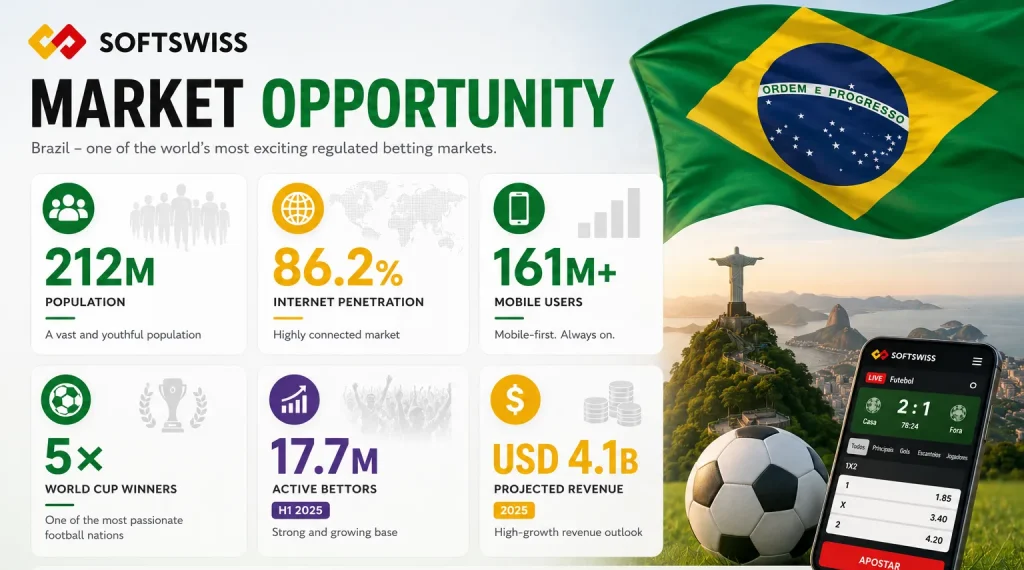
The numbers make a compelling case for any operator looking to start an online sportsbook in one of the world's most dynamic emerging markets. Brazil's population stood at 212 million in January 2025, with 183 million individuals using the internet – representing an online penetration rate of 86.2%. Mobile internet penetration reached 86.2%, encompassing over 161 million active online users.
Football is not just a sport in Brazil – it is a cultural institution. The country has won the FIFA World Cup five times, more than any other nation, and domestic passion for the game translates directly into one of the world's largest sports-betting consumer bases. Internet access is present in 92.5% of households, and there is a great passion for sports, especially football, which is part of Brazilian identity and culture. From January to June 2025 alone, 17.7 million Brazilians placed wagers on 182 approved betting sites – a figure covering only the licensed, regulated market, with the grey market adding substantially more volume on top.
The financial scale is equally striking. Brazil closed its first year (2025) of full regulation as the fifth-largest betting market in the world, with an estimated revenue of EUR 3.8 billion, according to Regulus Partners. Revenue is expected to show a CAGR of 13.54% through 2030, reaching a projected market volume of EUR 3.2 billion by that year.
For any operator evaluating the Latin America gambling market, Brazil is the undisputed anchor. Understanding sportsbook player profiles in this market – young, mobile-first, football-obsessed – is the first step toward building a product that converts.
Brazil's path to a legal sportsbook market is a decades-long arc from prohibition to full regulation. Gambling was broadly banned under 1940s legislation, but fixed-odds sports betting was granted public service status and quietly legalised via Federal Law Nr. 13,756/2018 – without the operational rules needed to enforce it. The grey market filled the vacuum: offshore operators served tens of millions of Brazilians for years, operating outside any local oversight.
That era ended with Law No. 14,790/2023. The law introduced clear rules and established the powers of the Secretariat for Prizes and Betting (SPA) under the Ministry of Finance, giving it the right to issue licences, control operator activities, and impose serious fines. The Ministry of Economy supports the broader fiscal and economic policy framework within which the SPA operates. Starting from 1 January 2025, only gaming companies duly authorised by the SPA/MF are allowed to operate and advertise in Brazil.
The framework is still evolving – tax rates, technical standards, and enforcement priorities have all shifted since launch. Continuous monitoring of Brazil's gambling regulation is not optional for any operator that intends to stay licensed.
Foreign operators cannot run a Brazilian sports betting business from offshore. The law demands a locally incorporated entity, and the corporate setup is one of the most underestimated stages of market entry for foreign investors. The entity must also include at least 20% of Brazilian shareholding. Administrative presence is not symbolic – regulators expect real operational infrastructure on the ground.
The core steps:
The licensing process is administered by the SPA under the Ministry of Finance and involves extensive technical, financial, AML, and responsible gambling compliance checks. Following the launch of Brazil’s regulated betting market on 1 January 2025, the number of authorised operators has steadily increased, with dozens of definitive and provisional licences already issued.
By 2026, the regulated market included more than 80 authorised operators and nearly 200 active brands. While Brazil does not impose a fixed cap on licences, all approvals remain subject to SPA regulatory discretion and strict compliance requirements.
Requirements span five categories: legal standing, tax and labour compliance, integrity, economic and financial qualification, and technical qualification. Authorised companies may operate up to three trademarks in Brazil.
Review the current compliance requirements before submitting your application. Using certified and regulation-ready solutions can help streamline the approval process. Incomplete corporate documentation is the most common reason applications stall at the SPA.
Compliance in Brazil operates on two parallel tracks simultaneously. The first concerns platform and infrastructure certification. Under SPA/MF Ordinance No. 722/2024, the betting systems must be technically certified by Ministry-of-Finance-recognised laboratories – GLI, Trisigma BV, eCOGRA, or BMM North America. Independent verification and ongoing compliance attestation by accredited laboratories are mandatory, covering security, transparency, and fairness. These are not one-time certifications – they are recurring obligations tied directly to licence validity.
The second track concerns operator-level compliance. Internal audit procedures, responsible gambling controls, AML mechanisms, and real-time reporting aligned with SIGAP requirements must all be operational before launch.
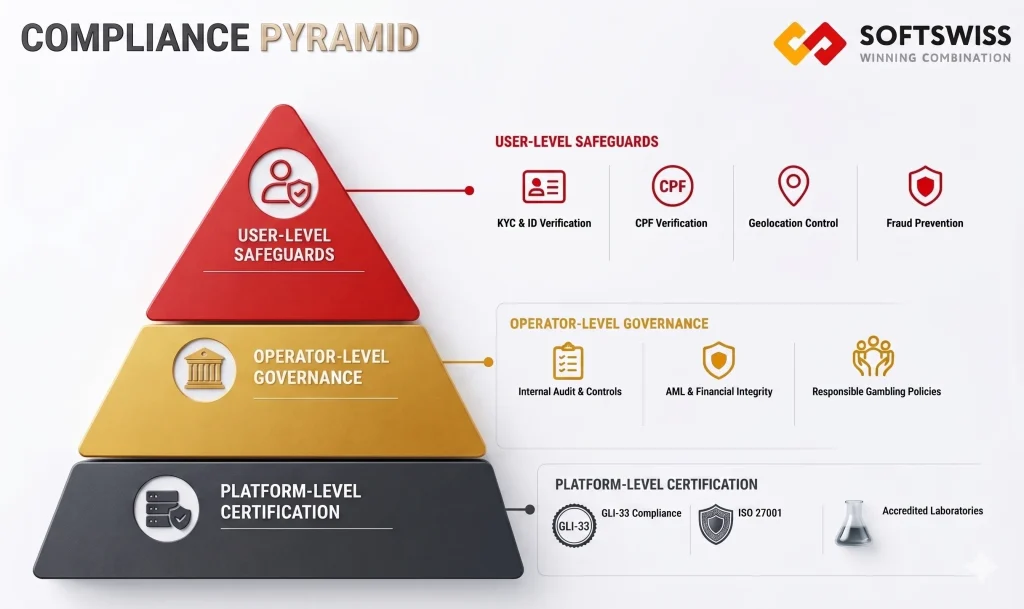
The framework includes identity verification through CPF (Brazil's personal taxpayer ID), restrictions on payment methods, including the prohibition of credit cards, and requirements for geolocation, cybersecurity, and fraud prevention.
AML obligations are governed by Ordinance SPA/MF No. 1,143/2024, which extends to counter-terrorism financing and weapons proliferation prevention – well beyond basic money laundering checks. Match-fixing prevention is a separate, explicit integrity requirement under the law. KYC checks against the CPF database must be fast, accurate, and continuous – not a one-off onboarding step.
These obligations underpin both licence retention and player trust. Align processes with responsible gambling practices from day one – retrofitting compliance is far costlier than building it in.
Platform selection in Brazil carries more weight than in most regulated markets because technical certification is built directly into the licensing process.
As part of the technical certification framework, the SPA may require up to five separate certification documents depending on the operator’s setup:
Verify that any vendor you shortlist holds all five for the Brazilian market.
The technical baseline beyond certification includes mobile-first architecture, live odds via established data feeds, a PAM system, CRM, bonus engine, reporting tools, scalable infrastructure, and PIX and Boleto Bancário integration from day one.
The structural question is which deployment fits your situation. For operators launching a sportsbook in Brazil for the first time, a turnkey sportsbook solution gives a complete, ready-to-launch operation pre-configured for local requirements and eliminates the most common compliance and localisation bottlenecks.
If you are adding a sports betting vertical to an existing casino platform, API or iFrame integration lets you embed a fully functional sportsbook module directly into your current product without rebuilding the underlying infrastructure.
The SOFTSWISS Sportsbook supports both options. The SPA-compliant platform meets Brazilian regulatory and technical requirements, holds GLI-33 and ISO 27001 certificates, helping operators accelerate time-to-market. It supports more than 200 sports, delivers live odds through Betradar and Oddin.gg, offers mobile-first experiences, and enables a unified wallet across sportsbook and casino products.
"Tropicalising" – the industry's term for making a sportsbook genuinely Brazilian – goes far beyond translation. UX patterns, promotional mechanics, content calendars, and entire customer journeys must be rebuilt around Brazilian preferences, not adapted from a European or North American template.
Operators should commission user-experience surveys with real Brazilian bettors before finalising UX decisions, and consult local market specialists who understand the cultural nuances that data alone cannot capture. Cultural adaptation done properly turns a foreign product into a local legal sportsbook brand that players actually trust.
Localisation checklist: Brazilian Portuguese copy → culturally relevant UX patterns → locally themed promotions tied to the domestic football calendar → multi-currency support → local payment integration → 24/7 Portuguese customer support.
PIX, operated by the Brazilian Central Bank, is the default expectation for any deposit or withdrawal in the Brazilian market. Any online bookmaker launching without PIX integration starts at a structural disadvantage that no marketing budget can overcome.
Boleto Bancário extends reach to unbanked and underbanked Brazilians – a significant share of the bettor population. Evaluate payment solution providers that offer pre-built PIX and Boleto connectivity with competitive processing fees and documented local presence.
The sports menu defines who you attract; bonuses and marketing convert and retain them. To become a successful sports bookie in Brazil, a product and acquisition strategy must be built together, not sequentially.
Football is the gravitational centre – comprehensive coverage of Brasileirão Série A, Copa do Brasil, and international tournaments is the baseline expectation of every Brazilian bettor. Basketball, tennis, MMA, and eSports differentiate the offering for younger demographics and protect against football seasonality. In-play betting across all major leagues is a key engagement driver and a growing share of total handle.
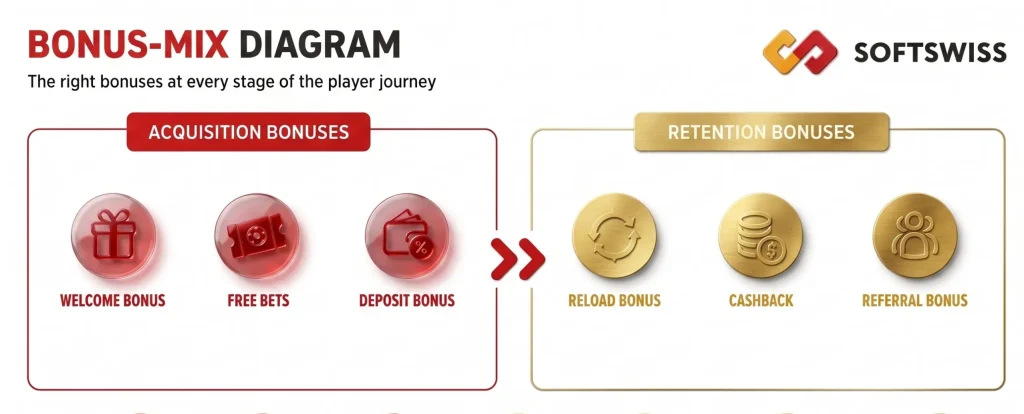
Structure your bonus stack around two distinct jobs: acquisition and retention. Welcome bonuses with transparent, fair wagering requirements generate launch buzz and drive first deposits.
A layered retention stack – reload bonuses, cashback on losses, deposit bonuses tied to recurring events, and referral bonuses for player-led growth – drives the lifetime value that makes unit economics work.
Free bets on marquee football fixtures remain one of the most effective activation mechanics in the market. Ensure every bonus mechanic is supported by the platform's bonus engine and risk management guardrails. See the full range of bonus types that can be offered by operators.
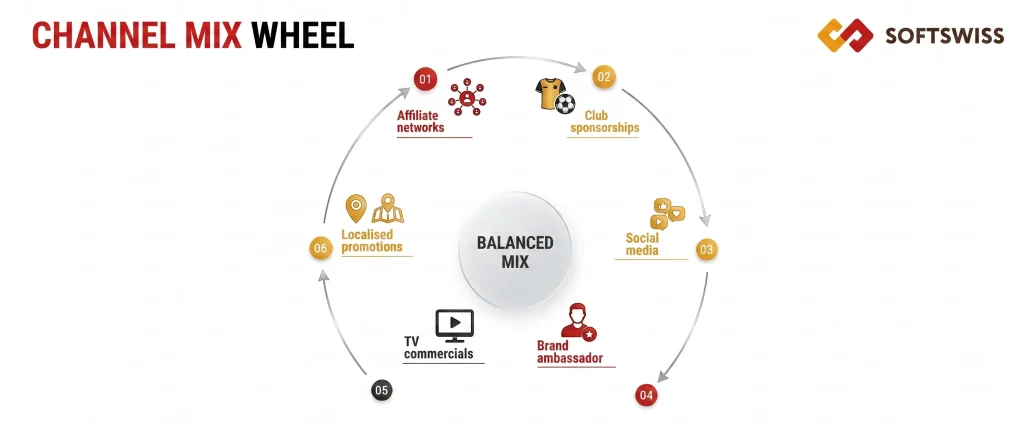
Building brand awareness in Brazil requires cultural credibility, not just spending. The most effective channel mix combines: affiliate networks with established Brazilian traffic, Série A club sponsorships (Flamengo, São Paulo, and Corinthians carry enormous reach), high-engagement social media (Brazil ranks among the world's highest for social media usage), a high-profile Brazilian brand ambassador – ideally a recognisable football figure – and TV commercials targeting the broad broadcast audience.
Consistent, locally resonant brand consolidation across all channels is what separates operators that acquire players from those that actually retain them, grow their user base, and follow the right steps to grow a sportsbook into a sustainable Brazilian sports betting business.
Tax planning cannot be treated as an afterthought when you make a sports betting website for the Brazilian market. Brazil-licensed operators must pay a 12% tax on GGR income, with taxes distributed to multiple social allocations as mandated by Law No. 14,790/2023, including public health funding and anti-match-fixing initiatives.
The framework also includes 9.25% in PIS/COFINS – Brazilian federal social contribution taxes applied to company revenue, up to 5% ISS municipal services tax, and 34% in corporate profit tax. As these taxes apply to different bases, the overall effective burden can exceed 25% for most operators.
On the operational side, real-time odds management, active trading to adjust lines against sharp bettor activity, market exposure control across concurrent events, and a robust anti-fraud platform are what protect profit margins and keep a betting company licensed and viable over the long term. These are not optional features – they are the operational core of any operator that wants to run a bookmaker business profitably in Brazil.
Operators must offer round-the-clock Brazilian Portuguese-language customer support via free electronic and telephone channels – this is a licence condition. Live chat and a comprehensive FAQ section accessible directly from the platform are expected by Brazilian bettors and scrutinised by regulators.
Brazil operates an active consumer-protection ecosystem: PROCON-SP, the São Paulo branch of Brazil’s official consumer protection authority, and IDEC, the country’s leading independent consumer rights organisation, handle formal complaints and can escalate to regulatory action, while ReclameAQUI, Brazil’s largest public consumer complaint and reputation platform, functions as a public-facing reputation monitor that Brazilian consumers actively consult before registering with a new betting company.
Each authorised operator must pay a EUR 5 million (R$30 million) concession fee for a five-year licence. This is paid after SPA approval and must be completed within 30 days, or the application is automatically rejected.
Yes, without exception. Foreign operators are prohibited from offering regulated gambling without a locally incorporated entity headquartered in Brazil. A minimum 20% Brazilian shareholding is also required under current regulations.
PIX and Boleto Bancário are non-negotiable. PIX delivers instant 24/7 transfers at near-zero cost and dominates digital commerce. Digital wallets and crypto can complement the stack, but cannot replace these two core methods.
As of January 2025, operators pay a 12% tax on GGR. Combined with PIS/COFINS, ISS, and corporate income tax, the effective burden exceeds 25%. The GGR rate is legislated to increase incrementally through 2028.
For most foreign operators entering Brazil without an existing platform, a Turnkey Sportsbook Solution reduces compliance risk and accelerates time-to-market with SPA-ready infrastructure, local payments, and Portuguese localisation built in. Operators with existing platforms should evaluate Sportsbook Integration instead.