iGaming Infrastructure in 2026: What Operators Need to Know
iGaming Infrastructure in 2026: What Operators Need to Know
July 2, 2026
When operators talk about infrastructure, they rarely mean servers or hosting anymore.
In iGaming, infrastructure has come to mean something far more strategic: a modular platform architecture that powers an entire business. It sits behind every player interaction, every transaction, and every regulatory process, quietly connecting systems that need to work together without friction.
What is iGaming Infrastructure?
Kanstantsin Minakouski, Engineering Manager at SOFTSWISS, explains: “At its core, iGaming infrastructure consists of a central platform, a set of modular services, and the underlying technology layers that enable an online gambling operation to run reliably at scale. It forms an ecosystem of interconnected components, including player account management systems, game and sportsbook delivery services, payment processing capabilities, compliance and security controls, data and analytics platforms, as well as the networking, computing, and monitoring foundations that support them.”
These components are typically designed to operate as independent yet integrated modules, allowing operators to scale, replace, or enhance individual parts of the ecosystem without disrupting the broader operation. Together, they provide the resilience, performance, security, and regulatory support required to run modern iGaming businesses across multiple markets and jurisdictions.
Key Components/Modules of an iGaming Infrastructure
Component / Module
What it is for
Core Platform: Player Account Management
Manages player accounts, authentication, wallet balances, and gameplay access, while enforcing bonuses and responsible gambling rules.
Casino Content (game aggregation, game management, provider integrations)
Connects the platform to casino content providers through aggregation layers and direct integrations, managing game availability, launch, configuration, settlements, and jurisdiction-specific content rules.
Connects the platform to sportsbook providers and trading services, managing betting markets, odds feeds, bet placement, risk controls, settlement processes, and jurisdiction-specific betting configurations.
Wallet & Payment Solutions
Processes deposits and withdrawals through multiple payment methods, routes transactions, and records them in a secure, auditable ledger.
Compliance & Risk Management
Verifies player identity, monitors transactions for fraud and anti-money laundering (AML), and enforces jurisdiction-specific responsible gambling and regulatory rules.
Front-End Delivery
Delivers the player experience across web and mobile, typically via headless architecture for flexibility and faster updates.
Data & Business Intelligence
Collects, processes, and distributes operational and business data across the platform. Supports reporting, analytics, player segmentation, fraud detection, real-time decision-making, and regulatory reporting, while enabling data-driven optimisation of products and operations.
Security & Operations
Protects data and services through security controls and compliance frameworks (e.g. ISO 27001/PCI). It includes identity and access management, infrastructure and application security controls, monitoring, logging, tracing, incident response, disaster recovery, performance management, and continuous compliance with industry and regulatory standards.
What makes this infrastructure effective is not just the presence of these modules, but how they interact. A well-designed setup allows player registration, gameplay, transactions, and reporting to flow through a unified system, with clear audit trails and consistent logic across the platform.
This infrastructure must also align with recognised standards and local regulatory requirements. To ensure compliance, operators must have their systems tested by independent, accredited laboratories, such as Gaming Laboratories International (GLI) or iTech Labs. Standards such as GLI-19 (Interactive Gaming Systems) and GLI-33 (Event Wagering Systems) provide widely adopted frameworks for evaluating fairness, security, and reliability, but it’s important to keep in mind that each jurisdiction has its own set of mandatory standards that must be reviewed and complied with.
Now, the practical question is: how exactly do the components interact with each other within the platform? In the following sections, we will break the infrastructure into its core components and explain what each one does in the stack.
What Operators Need to Know About iGaming Infrastructure
How Infrastructure Works in Practice
Before launching, operators need to ensure that all systems – from the player account platform to payments and compliance tools are fully aligned with regulatory and operational requirements. Identity verification frameworks are designed to block unverified users from depositing or playing until the required checks have been completed. Payment flows must support authentication protocols such as Strong Customer Authentication (SCA), while sportsbook feeds must integrate reliably with settlement engines to guarantee that every accepted bet can be resolved, reconciled, and audited.
Once live, the focus shifts from setup to stability and scale: systems must handle traffic spikes during major events, process real-time data without delays, and maintain strict compliance controls even as the business expands into new markets. This is where architectural investments – such as modularity and event-driven design – begin to show their value.
To better understand why each layer matters in practice, it helps to examine what each one does – and what breaks when it does not work.
“When operators talk about infrastructure today, they are no longer referring solely to servers, networks, or hosting environments. In iGaming, infrastructure is the platform ecosystem that enables the business to operate at scale - connecting player management, content delivery, payments, compliance, and data services into a single operating model. Its effectiveness directly impacts performance, reliability, regulatory readiness, and ultimately the player experience.”
Aleksei Savitski
Head of Engineering at SOFTSWISS
Key Components of iGaming Infrastructure
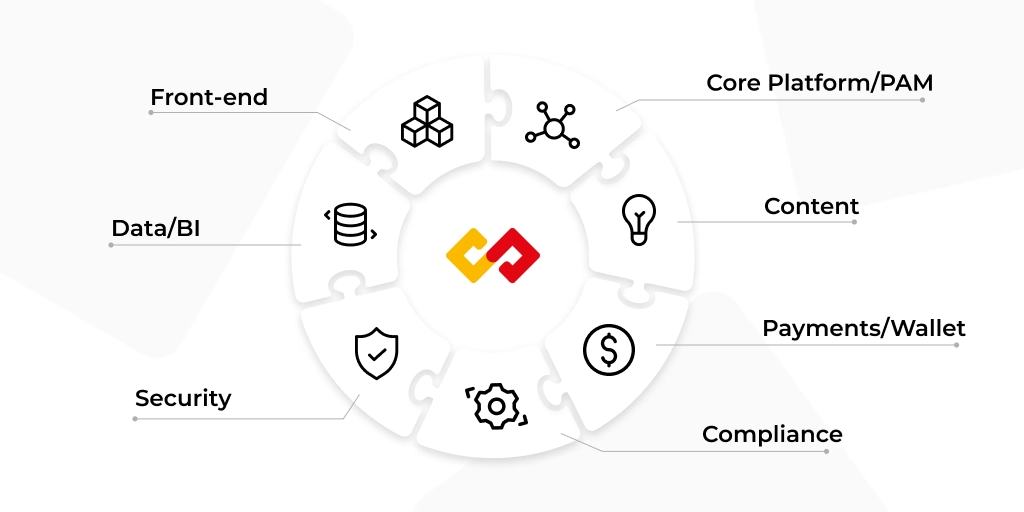
Although implementations may vary, most modern iGaming platforms are built around the same core layers, or modules.
Core Platform: Player Account Management
At the centre sits the Player Account Management system, or PAM. This is the operational core of the platform, managing player identities, authentication, account states, and wallet balances.
A modern Player Account Management (PAM) system should:
Handle registration and authentication (SSO for single sign-on; Multi-Factor Authentication, or MFA, for extra security).
Maintain account state, including a multi-currency, multi-balance wallet and ledger with an immutable record of every movement.
Manage session state, entitlements, loyalty and bonus engine logic.
Enforce responsible-gambling controls such as limits, self-exclusion, and reality checks.
Critically, the platform must allow compliance requirements to be enforced at the right times. If a player fails identity verification, the system must prevent deposits and gameplay automatically, without relying on manual intervention.
At SOFTSWISS, this takes the form of an API-first PAM with a single wallet and bonus tools embedded into KYC and RG flows, built to support multi-brand, multi-region operations without re-engineering the core. As an operator, that means one stable foundation for new skins, new markets and new verticals.
Content
This is where your platform meets what players actually consume.
For online casinos, this involves integrations with aggregators and Remote Gaming Servers, ensuring that only certified casino games are available and that content can be adjusted per market. A single iGaming platform can therefore support multiple jurisdictions, automatically enabling or disabling features based on regulatory requirements.
In practice, you can launch the same game catalogue across several brands while automatically disabling anything not approved in a given market without reworking or disrupting the platform in any way.
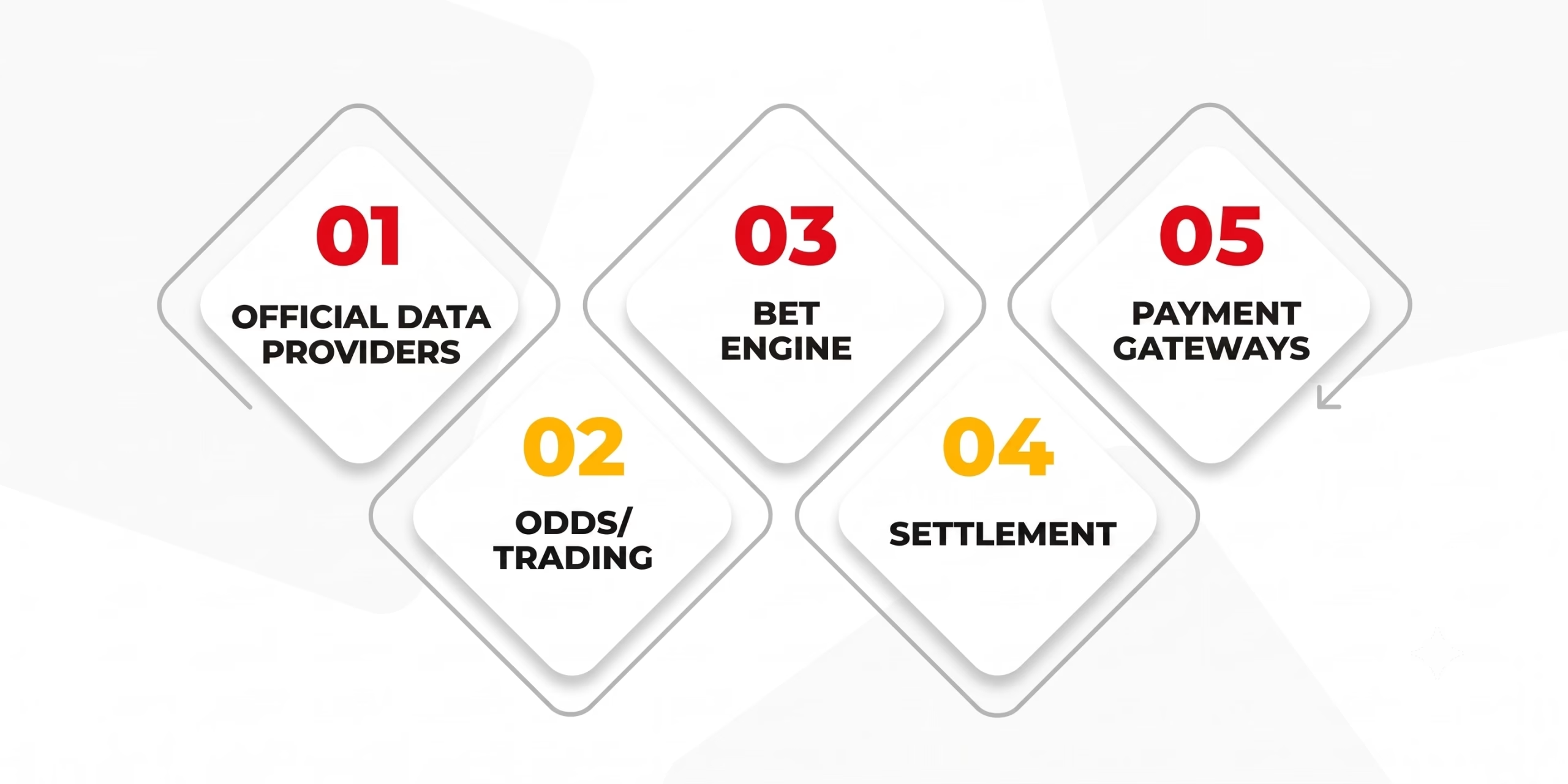
Official data and odds feeds supply fixtures, live updates and prices for pre-match and in-play markets. Low latency here means odds changes propagate in milliseconds, not seconds, with integrity safeguards in place.
Trading services update prices, enforce bet-acceptance rules and limits, ingest results, and write outcomes back to the wallet ledger.
Settlement services allow the full dispute trail to be mapped to event wagering standards (e.g., GLI-33-style requirements) so that acceptance logic and settlement remain auditable even during volatile moments, such as a penalty or VAR reversal.
In the SOFTSWISS architecture, feed adapters sit behind a single interface. That way, you can rotate or add providers without rippling changes into trading or wallet posting, and settlement remains consistent and auditable.
Wallet & Payment Solutions
Payments are often the most operationally sensitive part of the iGaming infrastructure.
A typical setup needs to support integration with reputable, secure payment service providers (PSPs) that offer a wide range of payment methods, while, behind the scenes, every transaction is recorded in a ledger that supports reconciliation, audits, and dispute resolution.
Because payments sit at the intersection of user experience, compliance, and revenue, this layer needs to be both flexible and tightly controlled.
Compliance & Risk Management
A typical compliance stack includes:
Know Your Customer (KYC)
Automatically verifies player identity, age, and physical location (can be skipped) during key lifecycle events such as registration, deposit, and withdrawal. The system approves clear matches instantly, while routing high-risk anomalies, failed checks, or conflicted data for manual review.
Anti-Money Laundering (AML) and Counter-Terrorist Financing (CTF)
Monitors transactions and player behaviour in real-time using a risk-based approach. The system runs ongoing PEP and sanctions screening, triggers source-of-funds validation, and flags suspicious velocity patterns, such as depositing and immediately withdrawing with minimal gameplay.
Responsible Gambling
Limits, self-exclusion and customer interaction are implemented in line with licensing rules and remote technical standards. Reality checks, limit changes and interventions are logged, reportable and auditable.
Technical Standards and Hosting Requirements
iGaming platforms operate within a complex framework of technical, security and regulatory requirements.
Infrastructure and operational processes are expected to align with:
Technical and security standards established by relevant gambling regulators
Information security management frameworks, such as ISO/IEC 27001
Regulatory requirements covering hosting, data protection, business continuity, and operational resilience
Independent testing and certification frameworks for gaming and sportsbook systems
Changes that affect regulated functionality must be subject to testing, validation and certification before deployment, where required.
Create a scalable technical foundation that supports integrations, market-specific configurations, and evolving regulatory requirements.
Data Protection
This is how the core principles of applicable data protection laws are embedded into flows and retention rules:
Analytics use anonymised data wherever possible.
Operational systems balance player privacy with regulatory mandates, retaining only specific categories of data and solely for the exact periods required by law (for instance, AML). Operational systems retain full records only where legally required.
DPIAs document risks and mitigations for higher-risk processing.
Once an erasure request is processed, all non-legally mandated data is immediately and permanently purged, ensuring adherence to data minimisation principles.
We have a system in place to ensure your data protection rights are processed efficiently and effectively. This framework ensures that player data copy requests or other data requests are systematically handled in accordance with regulatory timelines.
The result is a compliance spine that supports licensing, audits, and day-to-day decisions without overwhelming teams with manual work.
Navigating success in iGaming. The essential guide to launching or growing an online casino.
Front‑End Delivery
Frontend delivery plays a key role in how flexible the platform can be. Modern iGaming platforms increasingly use a headless approach, where the frontend is separated from the backend services. This allows teams to update interfaces, run experiments, and localise content without affecting core systems.
For operators, this means faster releases and easier brand differentiation. A single backend can support multiple frontends – across web, mobile, or retail – each tailored to a specific market or audience.
Data & Business Intelligence
Modern platforms are event-driven. Every player and payment action is emitted as an event to a streaming backbone such as Apache Kafka. Besides, a Change Data Capture (CDC) layer mirrors critical database changes into the stream, and a schema registry enforces versioned contracts so producers and consumers can evolve independently without breaking each other.
With a live event stream, you can:
Power real-time dashboards and P&L views by brand, sport or market.
Drive cohort segmentation and near real-time marketing.
Trigger responsible-gambling alerts and fraud checks within seconds.
At scale, many operators adopt a lakehouse architecture: a single, governed data store that combines the flexibility of a data lake with the performance of a warehouse. Stream processors build materialised views for operational use; batch jobs drive deeper analytics and machine learning.
In practice, a spike in voided bets can be detected within seconds and routed to risk teams, while the same stream updates executive dashboards and powers near real-time CRM segments.
Visibility into data, however, is only valuable if the systems generating it are protected, and security is the ultimate layer that brings credibility to the whole operation.
Security & Operations
This module provides the foundational capabilities required to operate the platform securely and reliably through security controls and compliance frameworks (e.g. ISO 27001/PCI). Protection is layered:
In transit: Transport Layer Security (TLS) encrypts traffic.
At rest: strong cyphers such as Advanced Encryption Standard (AES-256) protect stored data.
Keys and secrets: centralised key management and regular rotation reduce exposure.
Perimeter: a Web Application Firewall (WAF) and Distributed Denial of Service (DDoS) safeguards filter hostile traffic.
Inside the network: a zero-trust model with least-privilege Role-Based Access Control (RBAC) keeps access tight and auditable.
Data must be protected both in transit and at rest. Access must be controlled through strict permission models. Systems must be monitored continuously, with logs and metrics feeding into centralised tools that detect and respond to threats. Testing, monitoring, and incident response need to be part of everyday workflows, so that vulnerabilities are identified and resolved before they impact the platform.
Strengthen your infrastructure with a sportsbook platform designed for seamless integration, efficient operations, and long-term scalability.
To make this tangible, we have created a practical runbook. The checklist below serves as both a guide for launch and a set of controls to maintain reliability and compliance as you scale.
Launch & Scale Checklist
Before Launch
Before you go live, you should make sure that:
PAM & the wallet ledger are verified
Market-specific configurations are applied and validated
The KYC vendor is integrated and tested
The PSP mix is configured; SCA flows are validated end-to-end
The sportsbook live odds feed is integrated; the settlement chain is tested
Responsible gambling tools are configured
The GDPR DPIA is completed and signed off
ISO/IEC 27001 controls are mapped to the scope; the risk register is updated
PCI DSS scope is minimised; card data flows are reviewed
At Scale
After going live, you should continually:
Tune and load-test autoscaling policies
Monitor event streaming queue backpressure & consumer lag with alerts
Execute and document quarterly GLI/RTS regression tests
Perform periodic red-team/penetration tests and track remediations
In iGaming, infrastructure decisions have long-term consequences. Well-considered architectural choices lay the foundation for sustainable growth, enabling platforms to scale efficiently, expand into new markets, and adapt to evolving regulatory and operational requirements.
Kanstantsin Minakouski
Engineering Manager at SOFTSWISS
Best Practices for a Full-Proof iGaming Infrastructure
Modularity As a Foundational Principle
Modularity means the platform is built from small, well-defined parts that click together. Each part does one job and exposes a clear contract to the rest. This keeps change low-risk, lets teams ship independently, and makes it easier to meet different regulatory or market needs without rebuilding the core.
API‑First Approach
An API-first model reduces coupling, simplifies provider onboarding, and allows parallel roadmaps across Player Account Management (PAM), payments, risk, content and CRM. When a contract evolves, older versions remain available for a deprecation window, so dependent services are not forced to move in lockstep.
Plug‑and‑Play Verticals
With stable contracts, you can insert sportsbook, lottery, bingo, and other games without re‑platforming. Sportsbook, lottery, bingo or instant/crash games connect through the same authentication, wallet and reporting interfaces, while domain-specific logic stays inside each service.
The result is a catalogue of building blocks that can be combined per market, with jurisdictions switching features on or off through configuration instead of code changes.
DevOps
DevOps practices make sure that infrastructure changes can be deployed safely, monitored continuously, and rolled back when needed.
Resilience comes from running across multiple Availability Zones (AZs) and, where appropriate, adding multi-region failover, so a single data-centre issue doesn’t derail a peak event.
Real‑Time Architecture
Model actions as events and publish them to a streaming backbone such as Apache Kafka. A shared envelope (IDs, timestamps, correlation IDs) and a schema registry with versioned formats keep producers and consumers in step.
Define triggers where it matters: Responsible Gambling limits, Anti-Money Laundering velocity checks, and trading integrity rules subscribe to the relevant topics and act immediately, each with an owner and a runbook.
Watch the flow and scale ahead of spikes: track consumer lag and throughput; apply backpressure and auto-scale consumers during peaks to keep latency predictable.
Design for continuity: partition and replicate topics across multiple AZs, test failover, and set Recovery Point Objective or Recovery Time Objective targets where multi-region recovery is required.
Make decisions observable and secure: correlate logs, metrics, and traces via event IDs; send deduplicated, severity-based alerts to a SIEM system. Encrypt with TLS, enforce RBAC, and minimise PII in the stream.
Cost calculator
Online Casino Cost Calculator
Get a full financial breakdown of how much it costs to open an online casino – from infrastructure and licensing to payment systems, marketing, operations, and long-term retention - immediately, for free.
Final Thoughts
iGaming infrastructure is a modular, standards-aligned platform that can add products and markets without upheaval. Built API-first and event-driven, with cloud-native operations and a strong compliance framework, it turns scaling into a routine activity rather than a constant re-platforming exercise.
So, operators should start by using a launch checklist to close immediate gaps, then roadmap structural upgrades. When this foundation is in place, new verticals become configuration instead of a code nightmare, and regulatory audits feel like a routine, not a drill. In practice, many business owners choose to shorten this process by working with established platform providers.
A reliable technology partner like SOFTSWISS makes this far easier by providing:
A proven, API-first PAM with a single wallet and bonus engine
Pre-integrated content, payment and compliance modules
Experience across multiple markets, certifications and regulatory regimes
A mature security and operations model, shaped by real-world scale
By choosing the right tech stack, brands can build on a platform that already solves the hardest parts: reliability, compliance, scalability, and time-to-market. That frees operators and their teams to focus on what really matters – growing a resilient, profitable iGaming brand.
A single connection to the world’s leading content providers with over 40,000 games.
What is the difference between “platform” and “infrastructure” in iGaming?
In this context, “infrastructure” refers not just to servers or IaaS, but the whole modular platform stack (PAM, content, payments, compliance, data, security). “Platform” is often used to describe the commercial product you buy or build that sits on top of that stack and exposes it as a single solution to operators.
What is the difference between iGaming Infrastructure and an iGaming server infrastructure?
iGaming Infrastructure covers the full technology stack: PAM, content aggregation, payments, compliance, BI, security and front-end delivery. iGaming server infrastructure is the technical layer underneath – servers, containers, networking, load balancers, storage and cloud/hosting – that actually runs those modules.
Why is iGaming Infrastructure important for online casinos and sportsbooks?
A well-designed iGaming Infrastructure provides faster time to market for new brands and verticals, built-in compliance and security, the ability to scale up for big events without performance issues, and a cleaner operational model where audits, reporting and changes are predictable.
This directly impacts revenue, player trust and operational cost for any iGaming business.
How does iGaming server infrastructure affect performance and reliability?
Server infrastructure determines:
Uptime: redundant servers and multi-AZ or multi-region setups reduce downtime.
Latency: proximity to players, efficient routing, and tuned services keep response times low.
Capacity: autoscaling and load balancing allow you to handle traffic spikes during big sporting events or campaigns.
If this layer is weak, even the best platform will struggle under load.
Can iGaming Infrastructure scale globally?
Yes. A modular, API-first platform with cloud deployment and multi-region server infrastructure can support global expansion without re-platforming. It allows businesses to run per-region stacks to meet data residency and licensing rules, and share core services, such as payments, data and BI, where allowed. Brands can also conveniently localise content, payments and compliance configurations per market.
Do I need GLI certification?
Requirements vary by market and product scope. However, interactive gaming and event wagering standards, such as GLI-19 and GLI-33 style frameworks, are widely referenced by regulators and test labs, and often appear as part of certification pathways for casino platforms and sportsbooks.
What standards should security align with?
A typical approach includes:
Alignment with information-security standards such as ISO/IEC 27001
Implementation of the regulator's remote technical standards for security
Keeping card-processing components in line with card-security standards (like PCI DSS)
Embedding these controls into your day-to-day operations and CI/CD pipeline
How does GDPR affect my data architecture?
Designing around the core principles of lawfulness, purpose limitation, data minimisation, accuracy, storage limitation, integrity/confidentiality and accountability will translate into:
Clear lawful bases for data processing
Limited PII in analytics pipelines
Strong access control and audit logging
Retention policies that delete or anonymise data when it’s no longer required
Why are official sportsbook feeds important?
Official feeds provide rights-holder data with integrity controls. They support low-latency pricing, consistent settlement and regulator expectations for in-play markets, reducing disputes by anchoring results to audited sources.