
Knowledge Base
Maja Rajczyk
How to Start an Online Casino in South Africa
View Details
June 9, 2026

South Africa has been regulating sports betting since 1996, longer than most African nations have had a functional financial services sector. The result is settled law, mature digital infrastructure, an established competitive landscape, and the largest betting market on the continent – one that has been building habits for nearly three decades.
This guide covers how to start a sportsbook in South Africa from licence to launch: choosing the right provincial licence and sportsbook software, integrating payments, meeting compliance obligations, and reaching South African bettors through effective marketing.
Compliance does not end at licence approval. AML, KYC, POPIA, and responsible gambling obligations are actively monitored by provincial boards post-launch, making this a demanding online gambling business environment to operate in.
In 2026, South Africa is unambiguously Africa’s biggest betting market – driven by economic growth, institutional depth, and a South African bettor base with above-average spending power by African standards. The National Gambling Board reported ~€3.8 billion (R74.5 billion) in GGR for FY2024/25, with total turnover reaching a record ~€76 billion (R1.5 trillion) – a figure exceeding the nominal GDP of more than 40 African nations.
South Africa's online gambling market revenue tells a convincing story. GGR grew at a compound annual rate of approximately 34% between 2020 and 2025 before moderating to 26%. Betting drove that growth almost entirely, contributing approximately €2.6 billion (R52.3 billion) – 70% of total regulated gambling GGR. Online betting accounted for 60% of that amount.
According to GeoPoll's 2025 Betting in Africa survey, 83% of South African respondents had placed a bet in the past year – the highest participation rate on the continent, ahead of Kenya (79%), Tanzania (74%), and Nigeria (73%). These countries represent significant emerging markets for online betting, but none of them matches South Africa's regulatory maturity or infrastructure depth.
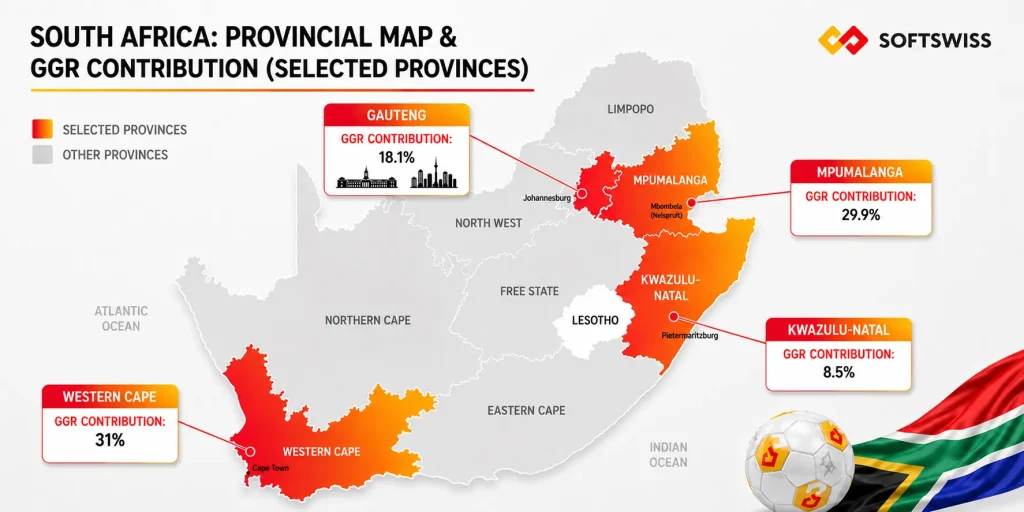
Demand helps translate market geography into a practical entry strategy. According to the NGB's FY2024/25 data, Western Cape holds 31% of GGR, Mpumalanga 29.9%, and Gauteng 18.1% – three provinces accounting for 79% of the market. KwaZulu-Natal contributes a further 8.5%.
South Africa has over 50 licensed operators, but the competitive landscape consolidates around a much smaller group at the revenue level that matters.
South African bettors have above-average spending power relative to other African markets, and their local betting behaviour – frequent, mobile-first, sport-specific – creates predictable acquisition hooks for operators willing to invest in targeted positioning toward the right target market.
For full context, view the South African iGaming market report and the applicable gambling regulation landscape before committing capital. Understanding sportsbook player profiles in the SA context will also sharpen your product and marketing positioning from the outset.
Operating a betting company in South Africa without a valid licence is a criminal offence – not a civil infraction. Personal liability extends to directors and key employees. Every sportsbook business must hold a valid provincial licence before accepting a single wager.
The National Gambling Act 2004 sets the legislation governing gambling jurisdiction across South Africa. The National Gaming Board provides national oversight; nine Provincial Licensing Authorities (PLAs) handle day-to-day regulatory compliance. A licence from one PLA is recognised for online sports betting nationwide. Review the full gambling licence in South Africa guide and the compliance framework before filing. Choosing the right gambling jurisdiction from the outset determines your long-term operating flexibility.
For full application requirements, probity standards, and fee structures, review the SOFTSWISS guide on getting a gambling licence in South Africa.
Platform selection is the most consequential technology decision any new sports betting business will make. The right sportsbook software determines your time to market, the depth of features you can offer from day one, and your capacity to scale as the customer base grows. Two primary paths exist: turnkey and proprietary software.
The right model depends on your available capital, desired go-live timeline, and the degree of product differentiation you need to compete. Preliminary cost-to-benefit analysis of iGaming software – before committing budget – is essential, since the gap in cost and capability between a basic sportsbook software provider and a full-featured B2B provider is substantial.
Building from scratch gives operators full ownership and maximum flexibility but demands significant capital expenditure, a large technical team, and a realistic 18-to-24-month build timeline.
A turnkey sportsbook solution delivers a more configurable foundation. The B2B provider delivers a complete sportsbook platform that the operator controls, with platform customisation options at the product and UX level. Development costs are moderate, and go-live timelines are measured in months.
When evaluating any B2B provider for sportsbook integration, apply these criteria:
Any sportsbook software provider that cannot satisfy these criteria creates operational risk.
The SOFTSWISS Sportsbook is licensed as a B2B provider by the WCGRB and GLI South Africa certified – operators avoid the technical audit timeline that typically adds months to a South African market entry. Native ZAR support, pre-built API integration with data feeds and KYC tools, and a SaaS delivery model mean infrastructure management stays with SOFTSWISS during year one.
The modular platform supports incremental feature activation, and scalability across high-concurrency environments is validated. The result is a compressed go-live timeline from licence approval to first accepted bet.
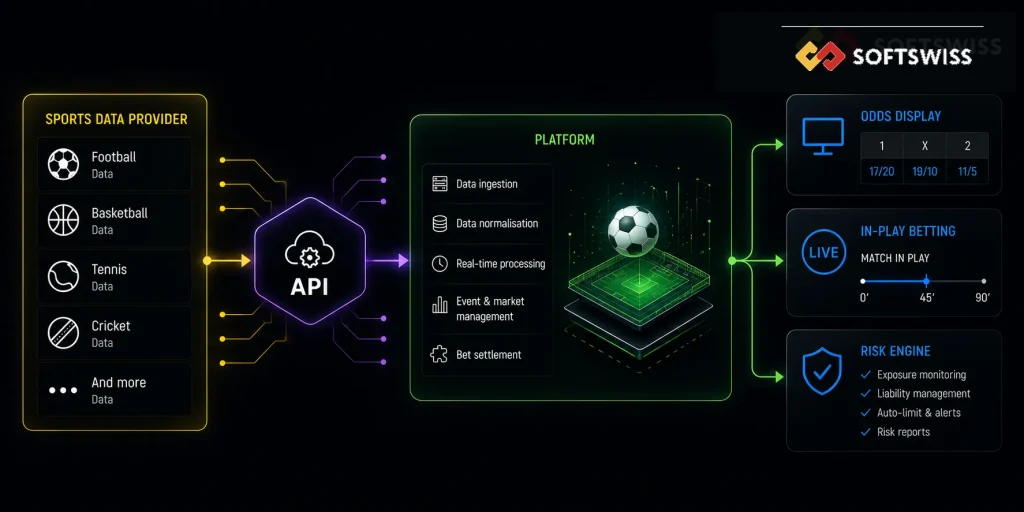
Sports data APIs and live data feeds power every bet – from pre-match lines to in-live betting markets and bet builder functionality. Odds management starts with feed quality; margin, liability, and settlement all depend on data that is accurate, complete, and on time.
Evaluate providers against four criteria:
The data flow: sports data provider → API → sportsbook platform → odds display and risk engine simultaneously.
SA's payment landscape reflects a partially unbanked, deeply mobile-native population. Your payment stack must be designed for that reality.
Recommended payment methods by category:
All transactions must be in South African Rand (ZAR). Local currency deposits build bettor confidence. Fast payouts and instant withdrawals are among the strongest retention levers available.
Integrate with multiple payment service providers – ensure your payment gateway supports failover routing. Secure payment processing requires SSL encryption, PCI-DSS alignment, and fraud prevention protocols across all touchpoints.
With smartphone penetration at 81% and mobile phone connectivity as the primary internet access method, mobile-first design is non-negotiable for any competitive sports betting app or platform.
A dedicated mobile version – native app or responsive web – must perform on mid-range Android devices that dominate the SA market. Your sports betting app is the primary interface through which most South African bettors will experience your business. Consult the sportsbook website launch checklist before going live.
Five conversion levers, ranked by impact:
Support English, Afrikaans, Xhosa, and Zulu at minimum. ZAR must be the default currency. Content and promotions should reflect regional sports preferences – rugby in the Western Cape, soccer in Gauteng and KwaZulu-Natal. Localisation drives conversion; it is not a cosmetic add-on.
Horse racing involves a distinct institutional framework: Gold Circle and Phumelela manage totalisator systems and on-course bookmaker relationships; the Kenilworth Racing Trust represents the Western Cape racing industry.
Any operator adding horse race betting must understand how these bodies interact with provincial regulators. In-live betting and bet builder are the two highest-margin product enhancements post-launch.
The compliance framework must be built before launch – it will be tested by regulators, sophisticated bettors, and fraud actors, often simultaneously. AML/KYC, responsible gambling, and cybersecurity are not independent pillars; they share infrastructure and data and should be designed as one integrated system. Cybersecurity obligations include SSL encryption across all data touchpoints. Gambling advertising laws require mandatory responsible gambling messages in all communications.
Review compliance obligations in full and register with the responsible gambling programme in South Africa before accepting the first bet.
Licensed operators are accountable institutions under the Financial Intelligence Centre Act 38 of 2001. KYC controls – know your customer procedures – are the operational mechanism for meeting anti-money laundering obligations per player. Requirements include:
Mandatory responsible gambling tools include self-exclusion, deposit and betting limits, reality checks, and links to problem gambling support. These risk management tools share infrastructure with operational controls: exposure limits per event, balanced book monitoring, and liability tracking dashboards. Review the responsible gambling guide for an operator-level implementation framework.
Gambling advertising laws under the National Gambling Act 2004 require responsible gambling warnings in all communications, the National Responsible Gambling Programme helpline, and 18+ participation statements.
In a market where Betway and Hollywoodbets hold national brand recognition, a clear positioning statement and unique selling proposition must be defined before any channel spend. Your marketing strategy must be built around compliance constraints from the outset.
A deposit bonus and free bets welcome offer is the industry baseline. Cashback reduces churn following losing runs. VIP memberships with loyalty rewards retain high-value players. Gamification mechanics – themed tournaments, leaderboards, milestone rewards – sustain engagement between major sporting events via CRM-triggered personalised offers. Provincial boards require clear bonus terms, including wagering requirements and withdrawal limits. Review casino bonuses 101 for an operator-level design framework.
The costs that surprise new operators are not the headline figures – they are the accumulation of line items absent from most startup costs budgets: compliance audits, integration patches, bonus liability, and annual investigation fees.
Hidden costs – maintenance costs, patches, and overhead expenses – accumulate before first-bet revenue. Build a 20% contingency reserve. South African tax law imposes GGR-based levies, VAT, and corporate tax on profits; payroll and PAYE obligations begin at the first hire. Cash flow planning between licence approval and first meaningful revenue is the most important financial discipline. Engage a financial consultant familiar with gambling tax law from the outset.
Use the sportsbook budget calculator for a tailored projection.
Yes, without exception. The National Gambling Act 2004 requires a valid provincial bookmaker licence before accepting any bet. Operating without one is a criminal offence with personal liability for directors and key employee licence holders.
WCGRB application fees start at approximately R13,800, with an annual investigation fee of approximately R11,000 – but total startup costs, including tech, marketing costs, and data feeds, typically reach R5.3M–R22.6M+ in year one. Use the sportsbook budget calculator for a tailored figure.
Yes. South African law permits crypto gambling under standard AML compliance. Bitcoin and Ethereum are most common. Cryptocurrency payments reduce processing costs and accelerate instant withdrawals.
Six to twelve months realistically. The betting licence application takes six to nine months. A turnkey solution adds three to six months of platform integration; a white label deployment takes weeks. Any promise of sixty days from a standing start means compliance corners are being cut. Use the sportsbook budget calculator and budget for the realistic timeline to start a sportsbook in South Africa.