
Need to improve on player retention? Learn the ins and outs of sports betting bonus types.
Nigeria and sports betting are a true match, with a betting participation rate of over 71% and a national enthusiasm for football. Well-established demand, Africa’s largest population, and a reliable payment ecosystem – no wonder the market is appealing to bookmakers.
The article covers the essentials of launching a sports betting business in Nigeria, including licensing, player behaviour, sportsbook integration, and more, to turn curiosity into a well-rounded understanding.
Is Online Sports Betting Legal in Nigeria?
Yes, sports betting is legal in Nigeria within a licensing-based regulatory framework. Operators are required to obtain appropriate licences to offer services, while the minimum legal age for participation is 18.
Over the past few years, Nigeria's regulatory framework has been changing progressively. The country is divided into 36 federal states, which have gradually gained the autonomy to issue their own licences:
Centralised Federal Licensing (2005–2024)
During this period, the National Lottery Regulatory Commission (NLRC) was the only licensing authority in Nigeria. It acted under the National Lottery Act of 2005 to regulate gambling activities, protect players, and foster economic growth. Operators used to obtain a single federal-level licence entitling them to offer sports betting nationwide.
State-By-State Licensing (2024–2025)
In November 2024, the Supreme Court abolished the National Lottery Act of 2005 and limited the NLRC's authority to the FCT (Federal Capital Territory, which includes the capital city, Abuja). All other states were granted the exclusive right to regulate gambling activity within their jurisdictions. For bookmakers, that meant obtaining a separate licence for each state in which they wanted to operate, rather than a single nationwide licence.
Multi-State Licensing (2025–Present)
To address operator confusion caused by multiple licences and overlapping taxes, the Federation of State Gaming Regulators of Nigeria (FSGRN) was created. It established a unified framework for gaming regulation among member states. In particular, it introduced the Universal Reciprocity Certificate (URC), which acts as a single, mutually recognisable licence for all member states (25 out of 36 as of April 2026; the list of member states can be updated over time).
Operators holding a URC can legally offer betting services in 25 states (out of 36). For non-member states, licences must be obtained separately.
Importantly, Northern Nigerian states restrict gaming activities. A secular constitution co-exists here with Sharia law, which considers gambling to contradict Islamic principles. In practice, gambling regulation here varies from complete prohibition to regulatory uncertainty. The map reflects the state-by-state status as of 2025:
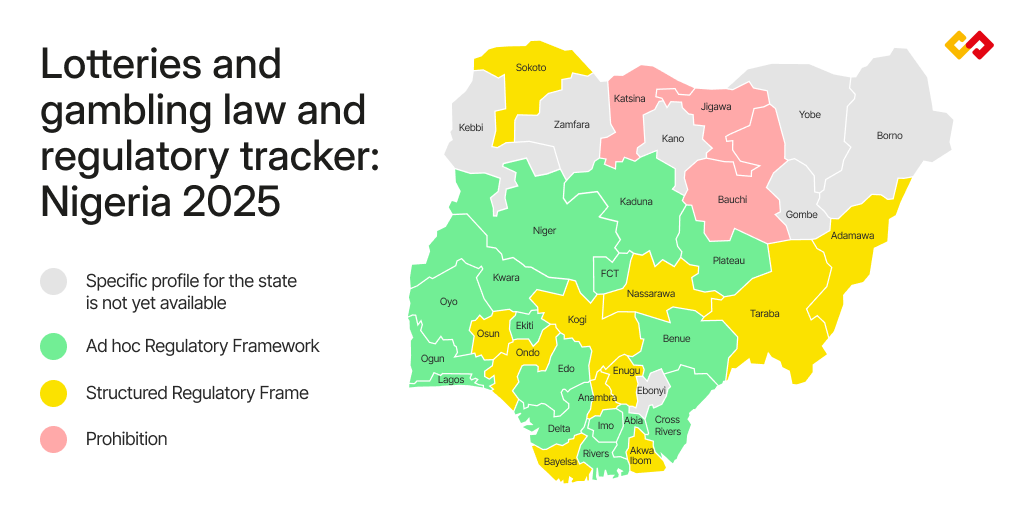
Source: Aluko & Oyebode
A Snapshot of the Nigerian Sports Betting Market
With more than 242 million citizens, Nigeria has the largest population in Africa. It’s also one of the most youthful countries in the world, as over 60% of the population is under 30. Almost 25% of adults gamble daily, generating $5.5m (approximately €4.7m) in overall spending, while sports betting accounts for 75% of all wagers. Territory-wise, the majority of players are in Lagos (over 40%), Port Harcourt, and Abuja.
Various research highlights such predilections for betting engagement, such as:
- Seeking alternative sources of income
- Recreation and entertainment
- Emotional effects like thrill-seeking, competition, and a sense of achievement
- National passion for football
- Increased broadband connectivity and smartphone adoption
- The expansion of online betting, available to people in rural areas
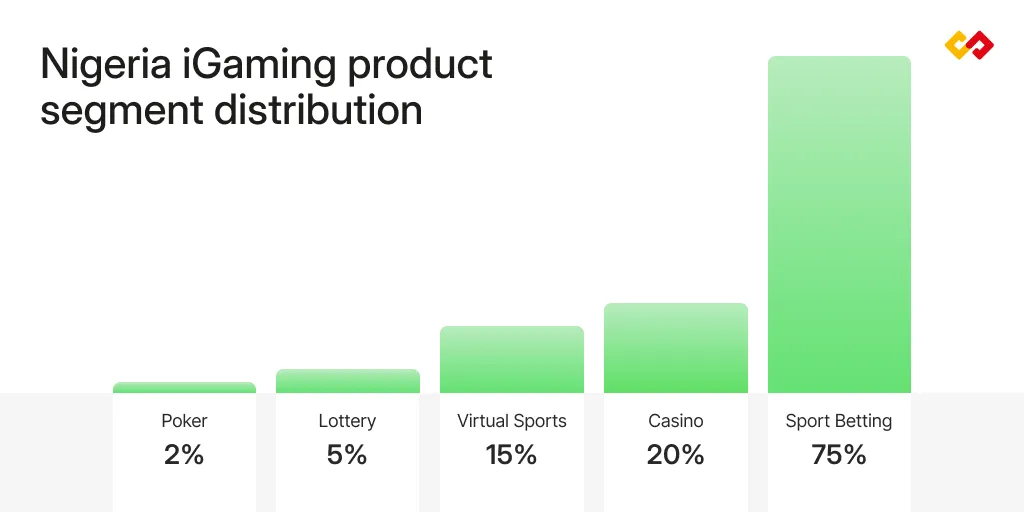
Source: igamingtoday
Players prefer digital betting platforms over brick-and-mortar venues, placing up to 93% of all bets online. As over 90% of users access the Internet through mobile devices, betting in Nigeria is mobile-first.
Among popular sports to bet on, football is an unequivocal leader, making up 85% of total wagering. Nigerian fans are highly engaged with their domestic leagues (such as the Nigeria Premier Football League, Nigeria National League, and NWFL Premiership) and with foreign leagues, mostly European (the English Premier League, the UEFA Champions League, and La Liga are among the top examples). Spikes in daily wager volume are typical during football seasons.
Other popular sports include basketball, tennis, boxing, athletics, esports, and more. Player behaviour reflects a preference for placing small bets (up to ₦500, approximately €0.3) throughout the day. This may be an attempt to increase the chances while playing it safe. Over 80% of Nigerian players are sensitive to bonuses and loyalty points, which can motivate their operator preference and retention.
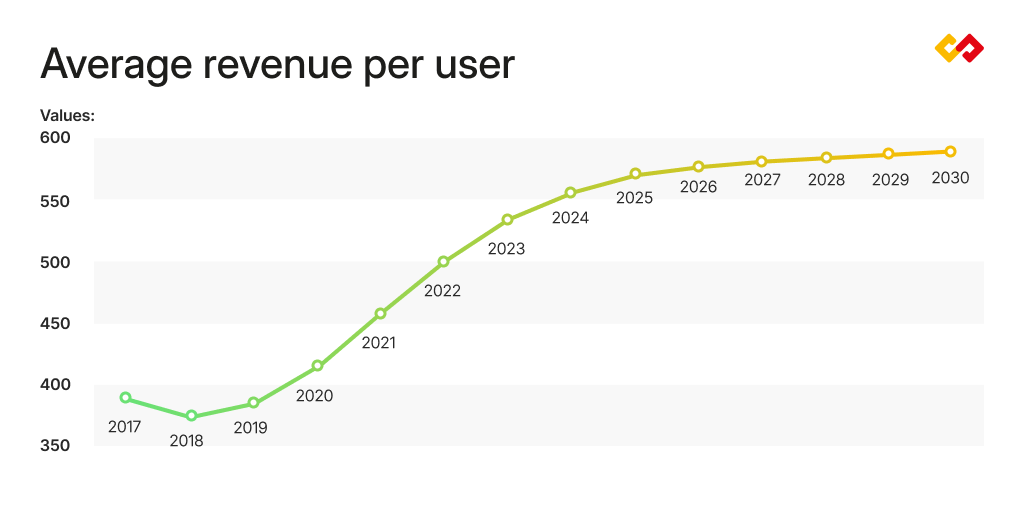
Online Sports Betting ARPU in Nigeria, by Statista
The online sports betting market in Nigeria continues to expand, with a forecast CAGR of 6.92% by 2028. A young, digitally active population, a deep-rooted football culture, and widespread betting activity create fruitful opportunities for sportsbook operators in this country.
RELATED ARTICLE
Sports Betting Bonus Types
How to Get a Sports Betting Licence in Nigeria
Both domestic and foreign sports betting businesses are eligible for a licence in Nigeria, provided they have evidence of business incorporation. Despite recent turmoil with licensing fragmentation, it has eventually evolved into two distinct options with transparent requirements.
Gambling Licensing in Nigeria – 2 Pathways
Moving on to the requirements, specific criteria may vary across institutions; however, both licensing types follow a similar logic. Some generally required information that betting businesses should provide includes:
- Business proposal. The description of the business operation and management structure; business, marketing, and distribution plans, comprising main KPIs projections.
- Financial information. Account statements, tax clearance certificates, source and extent of finance and capital investment, projected profit and loss, bank guarantee, etc.
- Sports betting operation. Relevant sports, number and frequency of sports games, approximate odds, prize and pricing mechanics, and more
- Tech stack details. Technical topography, including architectural diagrams, proposed platform and hosting type, information on servers, databases, operating systems, and more
- Certifications. ISO 9001:2015 certificates (Technical Partners/Bookmakers), Gaming Laboratories International (GLI) or BMM Test certificates, Special Control Unit Against Money Laundering (SCUML) certificate, and more
As for the timeline, application due diligence is often conducted within a minimum of 10–15 working days. If the application meets all pre-approval requirements, the bookmaker is granted a temporary Approval in Principle (AIP) licence valid for 90 days. Within this period, the sportsbook operator should fulfil all requirements provided in the AIP to obtain the substantive licence.
Follow the gambling regulation map to overview Nigeria’s regulatory landscape across more gambling verticals.
Tax Obligations for the Sportsbook Operators
The Nigerian fiscal framework for sports betting is changing towards simplification. From January 2026, staking amounts across all gaming verticals became VAT-exempt. In other words, operators no longer need to pay VAT (currently 7.5%) on players' stakes. Nevertheless, VAT continues to apply to platform, service, and commission expenses.
Players' winnings are subject to withholding tax (WHT). The rate is state-specific, but a widely applied benchmark is 5% for residents and 15% for non-residents. States can also impose additional levies – exemplified by a 2.5% tax on sales revenue for Lagos-licensed operators or a 5% tax on turnover in Oyo.
For operators holding a URC, the FSGRN introduced an 11% tax on Gross Gaming Revenue (GGR), regardless of the gambling category (sports betting, casino, lottery).
Bookmakers should also pay Company Income Tax (CIT). The rate is 30% if turnover exceeds ₦50M; otherwise, the company qualifies for 0% CIT.
Please note that the information provides a high-level overview and is valid as of April 2026. For a more detailed tax breakdown, operators should contact the local regulatory bodies and licensed professionals.
Payment Preferences of Nigerian Bettors
The dominant payment methods for Nigerian sports bettors are debit cards and bank transfers. Visa and Mastercard are widely adopted alongside Verve, the African domestic card brand. Supported by the Nigeria Inter‑Bank Settlement System Plc (NIBSS), interbank operations are instant, secure, and accessible.
Online payments are powered by NIBSS Instant Payments (NIP) – an electronic funds transfer platform which enables real-time person-to-person, business-to-business, and person-to-business transactions. NIP was recognised as the first mature instant payment system in Africa, particularly for its payment versatility, low consumer-side costs, and strong governance.
Thanks to Unstructured Supplementary Service Data (USSD), Nigerians can make payments, including betting-related ones, using short symbolic-numeric codes. USSD works only on mobile devices and is fully functional offline. This makes a difference in rural regions, where Internet connections may be unstable.
Among the top payment gateways in Nigeria are Paystack, Flutterwave, Moniepoint, and Interswitch. They enable fast and compliant processing of betting payments via cards, bank transfers, USSD, and more. The integration is typically API-driven.
The second well-established method for depositing and withdrawing funds is mobile solutions. OPay and PalmPay are considered the fastest and lead the Nigerian fintech market. Other popular options are Paga and Quickteller. Speaking of international e-wallets like PayPal, Skrill, and others, they are not as common for managing betting funds due to possible regional and compliance restrictions. That is why local fintech providers remain preferable for Nigerian online sportsbook operators.
In terms of crypto adoption, Nigeria is at the forefront: a 2024 survey found that over 84% of Nigerians own a crypto wallet, and over 74% have purchased cryptocurrency. These truly impressive rates present Nigeria as a promising market for crypto sportsbooks as well. The most widely owned and traded cryptocurrencies are Bitcoin, Binance Coin, and Ethereum.
Choosing the Right Sportsbook Software
Technology is the backbone of online betting. Sportsbook software brings the whole business model to life: it connects operators with players and players with wagering opportunities; ensures the transmission of funds and bettors' engagement; performs compliance and anti-fraud procedures; and much more.
That is why the sportsbook type and functionality are as much technical decisions as they are business ones.
Custom Vs. Turnkey Sportsbooks Compared
Depending on whether the operator needs a one-of-a-kind, proprietary sports betting software or a pre-built yet customisable platform, there are two possible options:
Custom Sportsbook Solution
A custom sportsbook is built from scratch to meet the operators’ individual requirements. It’s an exclusively owned software platform with unique interfaces, incentive mechanics, odds-provider integrations, embedded payment services, and more.
However, the ROI of a custom sportsbook is rather delayed. While the initial investment is high, the solution requires long-term development before it becomes profitable.
Turnkey Sportsbook Solution
A turnkey sportsbook is a preconfigured solution that can be purchased from a B2B provider, customised, and branded for a specific operator. It provides bookmakers with all the necessary features to manage players, stakes, payments, compliance, and more without the hassle of proprietary development.
The back office enables operators to flexibly adjust sports, bonuses, localisation, and other functional aspects of their sportsbook, while a customisable frontend provides a brand-aligned visual interface.
Turnkey sportsbooks are often compatible with other casino-related solutions, making integration easy. Due to the accelerated time-to-market, the break-even point comes much sooner.
Custom vs. turnkey sportsbooks overview
Another option is a white label sportsbook. It is technically the same, but comes with a licence secured by the B2B provider. Though seemingly advantageous, such a sportsbook falls short due to restricted jurisdictional recognition and high vendor control over the platform, both technical and commercial. For these reasons, operators comparing white label vs turnkey sportsbooks may favour the latter.
The SOFTSWISS Sportsbook Platform is a turnkey solution that offers granular CMS customisation, flexible gamification scenarios, integration with reliable odds providers, and more to maximise competitive advantage. Launch typically takes 14–30 days.

Launch and Grow Your Sportsbook
Start strong and scale efficiently with sportsbook technology built for evolving markets and player demand.
Essential Sportsbook Features
Whatever the type of sportsbook, features are what draw and engage bettors. These are some features that a sportsbook platform commonly comprises – from core to nice-to-have:
- PAM (player account management) ensures KYC compliance by collecting, storing, and managing customer data.
- CMS (content management system) is used to manage and customise content (such as text, visuals, layouts, etc.) on sportsbook websites and apps.
- Payment processing supports various payment preferences, including card payments, bank transfers, fintech apps, e-wallets, crypto wallets, and more.
- Odds provider integration provides players with trustworthy betting odds to facilitate their stake decisions.
- Sporting events attract fans of various sports, helping expand the audience and increase net gaming revenue (NGR).
- Analytics and reporting make it easy to track Sportsbook KPIs and provide transparency to all stakeholders.
- Gamification engages and retains players throughout their entire lifecycle with bonuses, loyalty points, tournaments, jackpots, and other incentives, helping a sportsbook stand out in a competitive market.
- Fraud prevention identifies and tackles fraudulent activity by setting account restrictions, implementing additional checks, alerting an operator’s team, etc.
- Help centre enables the customer support team to manage omnichannel requests and accelerate issue resolution.
A sportsbook budget calculator can help roughly estimate your future platform profitability.
Compliance and Responsible Gambling
While the feature set is up to operators to decide, Responsible Gambling and compliance are non-negotiable prerequisites for offering sports betting in Nigeria. These risk management practices safeguard both players and operators, though from different angles.
Responsible Gambling ensures fair, non-harmful betting. Its main objective is to prevent gambling disorder – an intrusive, poorly controlled urge to place bets despite adverse effects. It is achieved through impulse control tools like:
- Limits set on wagers, deposits, and losses
- Reality checks that periodically verify if the player wants to continue betting
- Cooling-off and self-exclusion periods that restrict players’ access to the sportsbook for shorter and longer durations, respectively
Compliance ensures that all sportsbook stakeholders, including operators, their service partners, and bettors, operate in accordance with Nigerian laws. Among the typical procedures are:
- Know Your Customer (KYC) verifies a bettor's identity through ID requests, proof of address, liveness checks, biometric verification, etc.
- Anti-Money Laundering (AML) implies thorough monitoring and reporting of suspicious transactions
For sportsbook operators, meeting compliance and Responsible Gambling requirements translates into an uncompromised brand reputation, while for players, it unlocks the benefits of betting without crossing red lines.
Launching a Sportsbook in Nigeria: Go-to-Market Roadmap
Connecting the points above into a cohesive set of steps, here is a high-level roadmap for operators to start a legal sportsbook business in Nigeria:
- Register a business with the Corporate Affairs Commission (CAC) – an official Nigerian business registry. Key deliverables for this step include a legal business entity, a Tax Identification Number (TIN), and a Nigerian bank account.
- Obtain a licence depending on which states your sportsbook is targeted for. A state-issued licence is enough to offer online sporting betting services in a specific state, while a Universal Reciprocity Certificate (URC) by the FSGRN permits legal operation across the currently 25 member states.
- Deploy either a custom-made or a turnkey sportsbook software solution. You can integrate a sportsbook into your existing casino website for a complete player experience.
- Enable popular payment methods in the Nigerian market. Local banks and payment solution providers are key integration partners at this step.
- Launch promotional campaigns to start acquiring bettors across the region where you are licensed. Analyse sportsbook player profiles in this region beforehand. Sports betting promotion regulation is not without its nuances in Nigeria, which we will look into further.
Promotional Strategies for Betting Businesses
Nigeria offers comparatively vast opportunities for sports betting promotion. To launch a promotional campaign in a specific state, the licensed sportsbook operator should align it with the requirements of the federal advertising regulator (the Advertising Regulatory Council of Nigeria, ARCON) and the state gambling authority (the Lagos State Lottery and Gaming Authority).
To harmonise siloed advertising requirements for multi-state operators, the ARCU recently partnered with FSGRN. They signed a memorandum of understanding (MoU) that unifies advertising rules across FSGRN member states. The agreement took effect on 1 April 2026. As the exact stipulations are not publicly available, it is better to clarify them directly with the relevant authority.
Switching to channels sportsbook operators can utilise for player acquisition, available options include TV, radio, print and online media, and social networks (the most used are Meta products like WhatsApp, Facebook, and Instagram, alongside TikTok and Telegram). SEO and PPC advertising create even more opportunities after Google reversed its blanket ban on gambling ads in 2025.
Affiliate marketing programs deserve special attention, as they combine a broad reach with a performance-based model. Driven by media, influencers, communities, brands, and online platforms, affiliate campaigns allow bookmakers to attract and pay only for pinpointed, highly relevant traffic. To prevent overwhelm from multiple campaigns, iGaming affiliate software enables centralised management. Bookmakers can analyse affiliate performance, set paid traffic criteria, adjust commissions, make payments, and more under one roof.
Sportsbook marketing strategy in Nigeria must comply with enforced regulations and promote responsible gambling. It is not allowed to target minors and vulnerable individuals, exaggerate winning chances, or emphasise easy earnings in particular.
RELATED ARTICLE
How to Start an Affiliate Marketing Program in 2026
Boost your iGaming brand with affiliates. Get the roadmap for a successful program.
Wrapping Up
Sports betting is the king of gambling in Nigeria, and football is the king of sports betting there.
While the regulatory landscape used to be heterogeneous, recent reforms have almost quelled the confusion around its silos. The trend is evident towards further streamlining of regulatory procedures to enable providers to enter the market smoothly.
An abundant population and a football-centric culture make Nigeria a fertile ground for sportsbook operators. But market competition is already high, and a new provider must outperform established brands. A feature-rich sportsbook with versatile bonus options can give a competitive edge.
Contact the SOFTSWISS team to get full-scale support with launching a sportsbook in Nigeria.
- Is sports betting legal in Nigeria?
-
Yes, the Nigerian gambling market is regulated. State-based authorities license bookmakers operating exclusively within their jurisdiction, while multistate operators can secure an FSGRN-issued unified licence. However, in Northern Muslim-majority states, the sports betting business varies from vaguely regulated to prohibited.
- How profitable is the betting business in Nigeria?
-
In 2025, gambling in Nigeria generated $3.86 billion in annual revenue, and 75% of all wagers are attributed to the sports betting vertical.
- How big is the betting industry in Nigeria?
-
By rough estimations, there are 40+ active betting businesses in Nigeria. Over a quarter of adults are involved in gambling, and the majority of them (75%) bet on sports events.
- What is the biggest betting company in Nigeria?
-
Bet9ja is considered a leader, with an estimated market share of 35–40%. It is followed by BetKing (20–25%), SportyBet (15–20%), Betway (10%), and 1xBet (5–10%).
- How to register a sports betting company in Nigeria?
-
To register a sports betting business in Nigeria, an operator should first register a business entity with the Corporate Affairs Commission (CAC) and then obtain a licence from the appropriate betting regulatory body.
- Which body regulates betting in Nigeria?
-
Betting regulatory authorities in Nigeria are represented by state-level bodies (e.g., Lagos State Lottery and Gaming Authority, Cross River State Lottery and Gaming Agency, Oyo State Gaming Board, and others) and the Federation of State Gaming Regulators of Nigeria. The latter enables operators to offer betting services in multiple states. If the operator targets a specific state, the state-level authority grants a licence for that jurisdiction exclusively.
- How much is a betting licence in Nigeria?
-
The licence fee varies across regulatory authorities. For a Lagos-issued licence, it is approximately €31k, while the FSGRN requested approximately €62k in 2026. In addition to the licence fee, operators are charged a non-refundable application fee and a licence renewal fee (after the current licence expires). In some cases, a bank guarantee is also required. To determine the exact costs, it is best to contact the relevant regulatory authority.