South Africa’s gambling market has become an attractive iGaming destination, as it offers a clearly structured regulatory framework, an established player base, and well-developed land-based and online betting sectors.
Unlike markets with a single central authority, South Africa demands a strategic approach involving provincial licensing and specific technical adaptations. This guide transforms the regulatory requirements into an actionable 7-step roadmap for 2026.
Disclaimer: The information provided in this guide does not, and is not intended to, constitute legal, financial, or tax advice; instead, all information, content, and materials available on this site are for general informational purposes only.
Key Takeaways
- Gambling licences are issued on the provincial level and include bookmaker, totalisator, bingo, LPM operator, casino (land-based), and key employee licences.
- Separate licences are not required for every province. A single provincial licence (e.g., from the Western Cape) acts as a ‘national passport’, allowing accepting wagers from players across the entire country.
- A Bookmaker Licence is a primary legal route for a digital operator, as traditional ‘Online Casino’ licences do not exist.
- Operations cannot be conducted through a foreign branch. Entrants must incorporate a local Proprietary Limited (Pty Ltd) company, open a local bank account, and appoint a resident Public Officer for tax compliance.
- Western Cape offers a transparent fee structure, with application fees ranging between €250-€750 and issuance fees of €2,500-€15,000, depending on licence type.

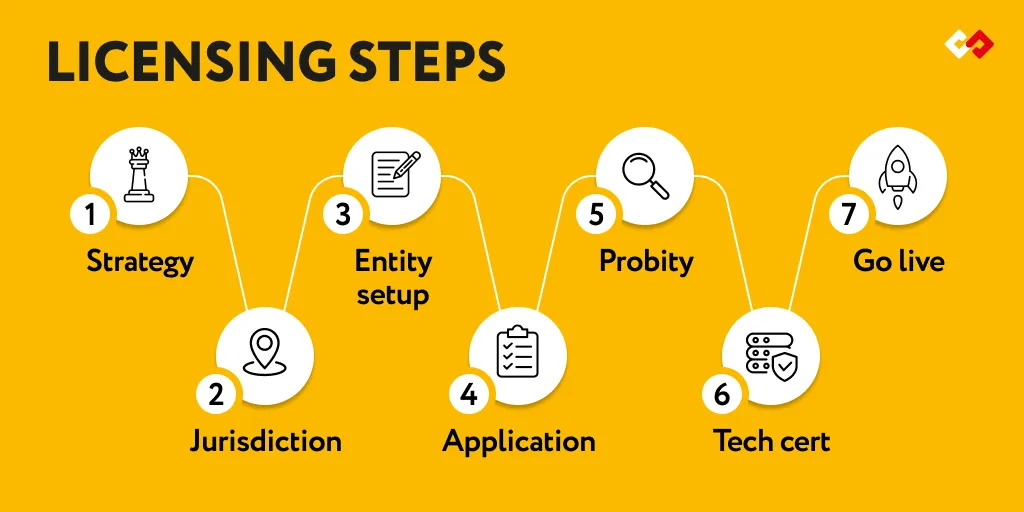
Step 1: Understand the Rules & Choose a Gambling Licence
South Africa does not offer a single national licence for operators. Instead, the market functions on a two-level regulatory system where national oversight and provincial enforcement intersect.
- National Level: The National Gambling Board (NGB) sets the overarching norms, standards, and limits under the National Gambling Act, oversees the South African gambling industry, but does not issue operator licences.
- Provincial Level: The nine Provincial Licensing Authorities (PLAs) are the actual gatekeepers – they interpret national law and issue the licences that allow operating in the country.
Types of Gambling Licenсes in South Africa
Provincial authorities recognise several distinct licence categories, each governing a specific activity. It is critical to understand that there is no active 'Online Casino' licence category; iGaming operators must utilise the 'Bookmaker' route.
- Bookmaker (Betting) Licence: Permits fixed-odds betting on sports, horse racing, and approved contingencies (which serves as the legal vehicle for online betting products).
- Casino Licence: Exclusively for land-based premises (hotels/resorts) and cannot be used for iGaming operations.
- Totalisator Licence: Authorises pool-based betting, primarily on horse racing.
- LPM & Bingo Licences: Restricted to physical gaming machines (Limited Payout Machines) in pubs and land-based bingo halls.
- Interactive Gambling Licence: While defined in national law, this specific online casino licence has never been implemented, leaving the Bookmaker licence as the only legal route for online entry.
- Manufacturer Licence: Required if you develop your own proprietary software or gaming hardware.
In the land-based sector, a physical casino licence is strictly tied to the province where the building stands – a Cape Town casino cannot legally serve a player in Johannesburg. However, the digital landscape is different.
A Bookmaker (Betting) Licence issued by any province functions as a universal passport. Once secured, it allows operators to accept wagers from players nationwide. You do not need nine separate licences to capture the South African market, you only need one robust one.
Step 2: Choose Licensing Jurisdiction
Since you can operate nationally from any province, you should ‘forum shop’ for the regulator that best aligns with your business model. In practice, operators prioritise provinces with mature regulatory infrastructure and proven commercial demand.
According to NGB data, three provinces dominate the commercial betting landscape:
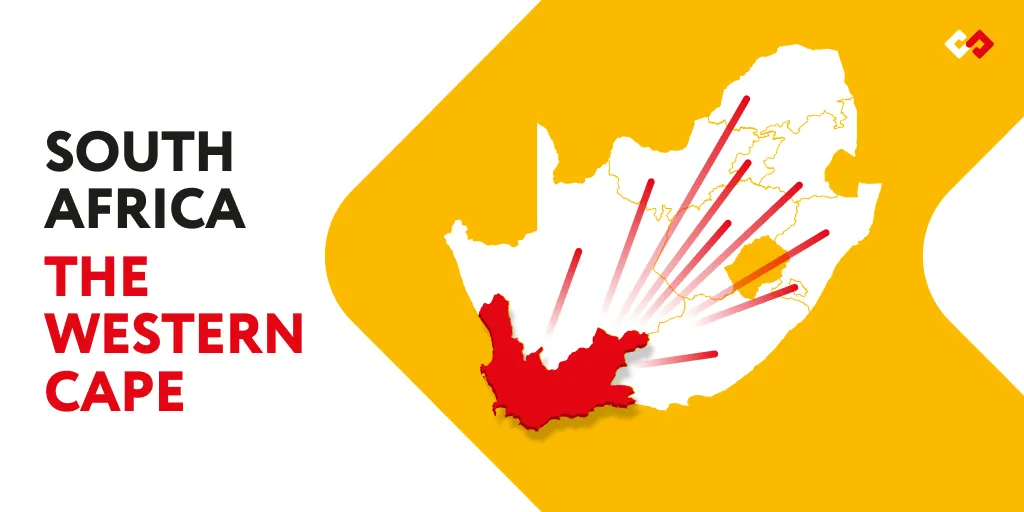
- The Western Cape: Widely regarded as the industry’s standard, the Western Cape Gambling and Racing Board is the preferred choice for international entities seeking transparency. Its clear, itemised legislative framework makes it the safest entry point for foreign compliance teams.
- Gauteng: As the country's economic heartland, Gauteng remains a critical hub for operators pursuing a retail-led or hybrid strategy. The local regulator issues licences to those wanting to capture the massive foot traffic in Johannesburg and Pretoria.
- KwaZulu-Natal: Offering a robust secondary market, the KwaZulu-Natal Gaming and Betting Board provides a stable alternative for operators looking to diversify their footprint beyond the primary hubs.
Why Choose the Western Cape

For the purpose of this guide, we chose the Western Cape as our case study. We have selected this jurisdiction not just for its commercial dominance but because it acts as the regulatory ‘gold standard’ for the entire continent, offering three distinct strategic advantages for foreign operators:
- ‘Licence on Demand’: Unlike other provinces that wait for rigid tender windows to open, the Western Cape accepts bookmaker applications on a rolling basis.
- Zero Retail Overhead: In most South African provinces, operators are forced to open a physical betting shop to get a licence. The Western Cape, however, defines the required premises simply as ‘where the business is managed'. This small legal distinction allows licensing a private office as official premises, letting operators launch 100% online without the cost of opening a retail store.
- The ‘Stress Test’ Factor: Its documentation standards are the most exhaustive in the country. If your compliance dossier can pass a Western Cape review, it is effectively ‘stress-tested’ and robust enough to satisfy any other provincial board in South Africa.
South African Gambling Licence Cost
The following breakdown outlines the Western Cape’s official licensing-related fiscal requirements for the 2025/2026 period. It provides a baseline for financial modelling, distinguishing between sunk administrative costs and the capital reserves required for operational security.
Exchange rate estimated at ZAR 20 = €1.
| Licence Type | Application Fee | Annual Licence Fee | Investigation Fee (Annual) |
| Bookmaker (Online Vehicle) | €755 | €151 | €604 |
| Bookmaker Premises | €755 | €31 | €75 |
| Casino Operator (Land-Based) | €30,205 | €15,103 | €453/table + €302/slot |
| Totalisator Operator | €15,103 | €302 | €7,552 |
| Totalisator Premises | €755 | €31 | €75 |
| Manufacturer / Distributor | €755 | €302 | €1,511 |
| Key Employee | €3,070 | €8 | €31 |
| Gambling Employee | €8 | €8 | €8 |
Step 3: Establish Local Entity
South African regulators do not issue licences to foreign branches or shell companies. To enter the market, the operator must establish a full legal presence in the country. This means registering a South African Proprietary Limited (Pty Ltd) company to act as the licence holder.
- Incorporate a local company via the Companies and Intellectual Property Commission (CIPC). You must appoint a Public Officer (a South African resident responsible for tax compliance) and maintain a physical office in the licensing province for regulatory inspections.
- Register with SARS (tax registration) before applying. Note that South Africa charges 15% VAT on Gross Gaming Revenue (GGR), plus a standard 27% corporate tax on profits.
- B-BBEE compliance is a key consideration in licensing. Although not a standalone legal requirement, regulators commonly apply it as a qualification criterion. In practice, many international operators target Level 4 status, as weak B-BBEE credentials can significantly increase the risk of licence rejection.
- Start this process three months early. South African banks are conservative and often reject complex offshore structures. A local account is mandatory to hold the required financial guarantees.
Step 4: Submit the Application Package
Use the following checklist as your final ‘Go/No-Go’ test. If any of these four pillars are missing or incomplete, the application will be flagged as non-compliant before the investigation even begins. Anyways, seek professional counselling to make sure you account for specifics and possible changes.
The Western Cape Benchmark Checklist
| Permit / Approval Category | Key Supporting Documents |
| Provincial Gambling Licence |
|
| Key Person Approvals |
|
| Premises Approval |
|
| Supplier / Tech Approval |
Step 5: Pass the Probity Screening
Prepare your stakeholders for deep due diligence. Once your application fee (approx. €250-€750) is paid, the regulator begins the ‘Probity’ phase.
Ensure all Directors, Shareholders, and Key Persons are ready to submit personal financial records and background checks. Budget for a 6–12 month waiting period. Proactively responding to regulator queries during this phase is the single best way to speed up approval.
Step 6: Certify Technology
Before a licence can be activated, the operator’s platform must be formally certified against South African National Standards (SANS). This is a forensic audit to verify that the software functions lawfully as a fixed-odds betting system, ensuring fairness, security, and accurate tax recording.
Core Technical Requirements
To obtain certification, the system must demonstrate three functional competencies during the audit:
- Fixed-Odds Logic: The engine must treat every transaction as a discrete bet with defined odds. The system must prove that the outcome is derived from a clear result source and that the potential payout is calculated before the event concludes.
- Real-Time Liability: The system must track the operator’s financial exposure in real-time. It must be capable of enforcing liability limits per event to ensure the operator maintains sufficient capital to pay out winning wagers.
- Immutable Audit Trails: Every bet must generate a unique, traceable transaction ID. These logs must be tamper-evident, ensuring that the regulator can reconstruct any transaction history for compliance or dispute resolution purposes.
Certification Process
- Select a Laboratory: The operator must engage an accredited Independent Testing Laboratory, such as GLI or BMM Testlabs.
- Audit: The lab tests the source code and operational environment against the SANS criteria.
- Letter of Certification (LOC): Upon passing, the lab issues an LOC. This document must be submitted to the Provincial Licensing Board to authorise the platform's deployment.
B2B tech partners like SOFTSWISS have already cleared the rigorous audit process and hold active product certifications with key provincial licensing authorities. By utilising a ‘pre-certified" turnkey solution, operators effectively inherit their compliance status. This allows bypassing months of expensive technical testing and focusing energy on what actually drives revenue: marketing and player acquisition.
Step 7: Finalise Fees & Launch
Before the physical licence is issued, the operator must settle the final issuance fees, a figure that varies by province but typically caps at approximately €15,000. Simultaneously, a regulator requires a tangible commitment to financial stability in the form of a Bank Guarantee. Usually ranging between €10,000 and €50,000, this capital is not an operational expense but a fiduciary reserve, held in trust to ensure that player liabilities can always be met, even in a worst-case insolvency scenario.
The following cost breakdown provides a conservative baseline for a standard ‘Online-Only’ Bookmaker entry, assuming a lean corporate structure and the use of a third-party turnkey platform.
| Cost Category | Item Description | Est. Cost (EUR) | Frequency |
| Regulatory Fees | Application Fee (Bookmaker) | €605 | One-off (Non-refundable) |
| Investigation Fee (Probity)* | €5,000 – €15,000 | One-off (Billable hours) | |
| Annual Licence Fee | €605 | Annual (Payable upfront) | |
| Key Employee Licence (Per Director) | €30 | Annual | |
| Operational Capital | Bank Guarantee (Security Bond) | €5,000 – €25,000 | Locked Deposit (Refundable) |
| Working Capital Proof | €100,000+ | Held in Bank (Proof Only) | |
| Technical Compliance | Platform Certification (GLI/BMM) | €5,000 – €15,000 | One-off / Major Updates |
| Setup / Integration Fee (B2B) | €10,000 – €50,000 | One-off (Vendor Dependent) | |
| Corporate Setup | Company Registration & Tax | €500 – €1,500 | One-off |
| Legal & B-BBEE Structuring | €2,500 – €7,500 | One-off | |
| Ongoing Taxes | Provincial Gambling Tax | 6.5% of GGR | Monthly |
| Value Added Tax (VAT) | 15% of GGR | Monthly | |
| Corporate Income Tax | 27% of Net Profit | Annual |
Note: Budget an additional €3,000 – €10,000 for software certification and €1,000 – €5,000 annually for local compliance consulting
Conclusion
Success in South Africa is defined by how efficiently you navigate its unique regulatory architecture.
By following this roadmap, anchoring your operation in the Western Cape and clearing its rigorous probity standards, you can secure a licence that serves as a universal passport for the entire country. In this landscape, technical compliance is the primary bottleneck.
Leveraging a SAR-certified tech partner converts this hurdle into an advantage, allowing you to bypass complex audits and focus your resources entirely on player acquisition and market growth.
- How long does it take to get a gambling licence in South Africa?
-
Licensing can take 6-12 months, depending on the province, complexity of the application, due diligence findings, and technical certification requirements. Industry submissions and provincial board reporting timelines consistently show extended processing periods due to due diligence depth and technical verification requirements.
- How much capital is required to start a licensed gambling operation?
-
Regulators require proof of financial sufficiency, and total entry costs often reach hundreds of thousands of rand once licensing, technical certification, corporate setup, and compliance staffing are included.
- What happens if an operator offers online casino games without a licence?
-
Unauthorised interactive gambling is illegal, and operators risk criminal charges, seizure of equipment, and administrative penalties. Players may also be subject to forfeiture of winnings.
- Is a gambling licence transferable in South Africa?
-
No. Licences are non-transferable and tied to the specific entity and individuals who passed suitability checks.
- Can foreigners apply for a gambling licence in South Africa?
-
Yes. Foreign-controlled companies may apply, provided they establish a South African entity, meet provincial suitability requirements, disclose all beneficial ownership, and comply with FICA and POPIA obligations. All directors and key employees, whether foreign or local, must pass provincial fit-and-proper checks.