

Sports betting odds explained: The essential guide for iGaming operators.
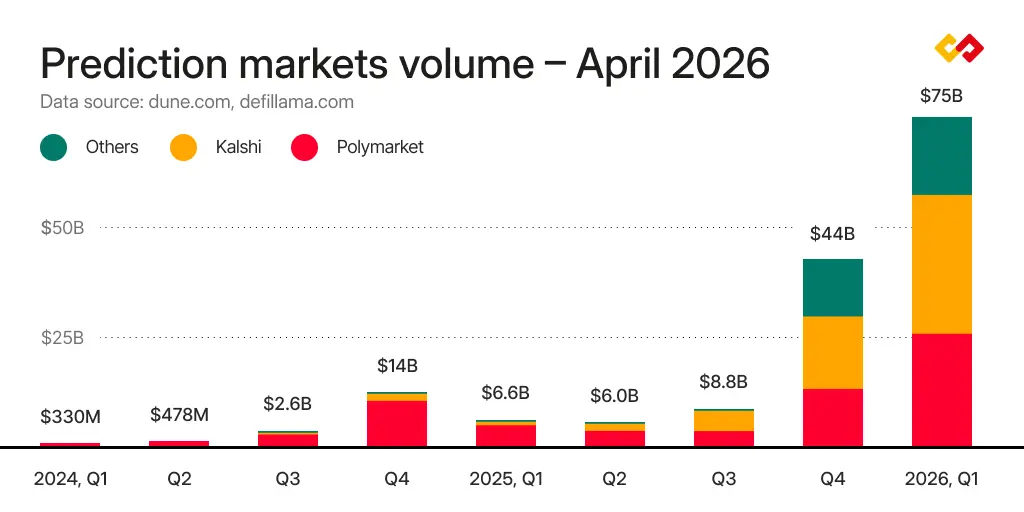
Prediction markets have been around for a long time, but 2025 was the year they became front-page news in the US. Much of this growth followed the 2024 US elections, when platforms like Polymarket and Kalshi showed that event-based trading, where participants put money on the outcome of real-world events and receive a payout if their prediction is correct, could attract a mass audience.
By the end of 2025, total activity across major platforms had exceeded $44 billion, underscoring how quickly the category was growing.
Regulators on both sides of the Atlantic started paying attention. As did iGaming operators, who began to question how prediction markets fit into their world. Many US online sportsbooks, like FanDuel and DraftKings, soon followed with brand spin-offs dedicated specifically to predictions.
The overlap is hard to miss. Bets, odds, payouts – all those mechanics are familiar to anyone in the iGaming business, especially those running a sportsbook. Except that the events don't end with sports. And for an industry constantly searching for new ways to engage players, that opens up clear opportunities.
This article covers what prediction markets are, how they work, where the regulatory lines are being drawn, and why iGaming stakeholders should be paying attention.
Key Takeaways
- Prediction markets operate primarily through peer-to-peer trading, as on platforms like Polymarket and Kalshi. Event-based betting (fixed-odds) is a high-potential new vertical for iGaming.
- Fixed-odds prediction markets follow a sportsbook model: users bet against the house, with odds derived from probability and fixed at the time of the bet.
- P2P prediction markets enable real-time price discovery and position trading, but they rely on strong liquidity (a steady flow of buyers and sellers) and more complex infrastructure to function effectively.
- For iGaming operators, prediction markets represent an “always-on” wagering vertical that is not bound to a sports season or schedule.
- Regulation remains fragmented, with prediction markets variably classified as financial instruments, gambling, or a grey area.
Prediction Markets Explained
A prediction market is a type of marketplace where people put money behind their expectations about what will happen in the future. Events are usually framed as simple yes-or-no questions, and participants can buy a position that pays out if they are right. The price of that position changes depending on how much money people are willing to commit to one outcome or the other, making it a straightforward way to see what the crowd believes is likely.
The idea is older than most people realise. Traders wagered on papal elections in 16th-century Europe, and by the early 1900s, Wall Street betting pools on US presidential races were common enough that the New York Times published their odds.
Prediction markets re-emerged in the 21st century, driven by the internet and academic interest in crowd forecasting. Today, they are popular for their ability to aggregate information and rival traditional polls.
As of 2026, two names dominate the conversation, both US-based. Polymarket, launched in 2020 and built on blockchain technology, and Kalshi – live since 2021. There are more peer-to-peer platforms beyond these two. For instance, PredictIt and Manifold operate on a smaller scale, very often focusing on a specific topic, but they are steadily growing their audiences.
When it comes to how they operate, prediction markets can be broadly divided into centralised and decentralised models. Centralised platforms, such as Kalshi, are run by a company that manages user accounts, holds funds, and settles outcomes, whereas decentralised markets use smart contracts to facilitate trading and payouts without a central intermediary.
How Do Prediction Markets Work?
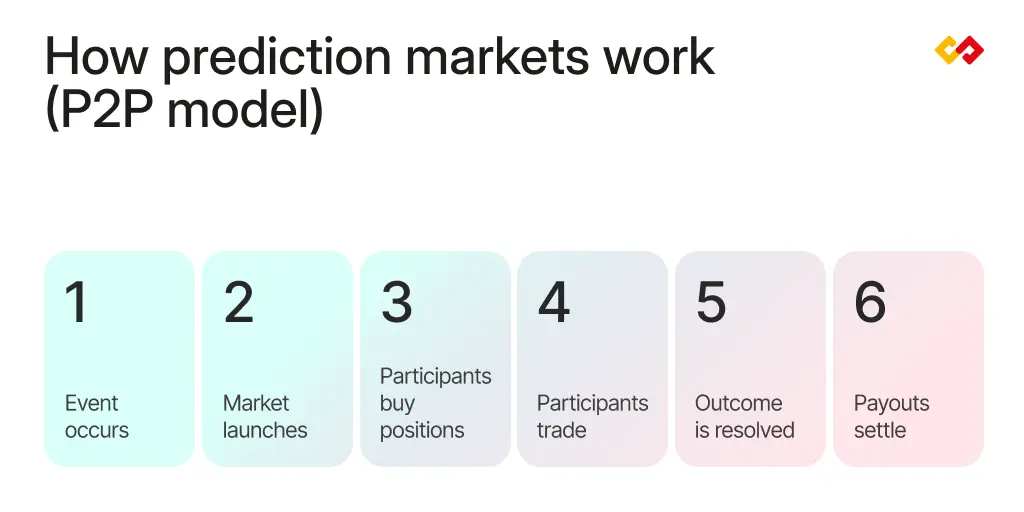
In a peer-to-peer model, participants trade directly with one another. Instead of placing bets, users buy and sell contracts (often called shares) tied to specific outcomes. Each contract has two sides and pays a fixed amount, typically $1, if the predicted outcome occurs. If it does not, the contract expires worthless.
Unlike a sportsbook, where odds are set by the operator, a platform does not set contract prices. Prices are determined by user trading activity and change with each transaction. At any given time, the price reflects what the market collectively believes the likelihood of an outcome is.
Here is how that plays out in practice. Consider a market asking: “Will country X enter a recession this year?”
Shares for each outcome (“Yes” or “No”) trade between $0 and $1. If “Yes” shares are priced at $0.65, the market is effectively assigning a 65% probability to that outcome.
A participant who believes that country X will enter a recession this year can buy “Yes” shares at $0.65. If the event occurs, each share settles at $1, generating a profit of $0.35 per share. If the event does not occur, the shares expire worthless, and the trader loses the initial $0.65.
So what makes the price change? If more traders want to buy “Yes” shares than sell them, buyers must offer a higher price, which pushes the price up. If more traders want to sell, the price goes down. In this way, prices continuously adjust as participants trade and new information enters the market.
If the perceived likelihood of a recession increases, more traders may start buying “Yes” shares, pushing the price up, for example, from $0.65 to $0.80. This also allows traders to sell early and lock in a profit without waiting for the final outcome.
Who Creates Markets and How Do Platforms Make Money?
Every platform has a dedicated team responsible for researching, structuring, and launching new prediction markets. These teams define the question, set clear resolution criteria, and objectively settle each market.
At the same time, platforms allow participants to suggest new market ideas. These proposals are not listed automatically. The team reviews them first and accepts them if they align with key principles:
- The risk of manipulation must be minimal to ensure a fair environment.
- The market must not encourage harmful or unethical behaviour.
- The outcome must rely on a trusted and verifiable data source.
Only markets that meet these standards are approved and made available for trading.
On the revenue side, prediction market platforms like Polymarket or Kalshi generate income through transaction fees, such as a small percentage per trade. Some platforms may also include fees on winnings or on market creation, ensuring sustainable operations while maintaining active, liquid markets.
Difference Between Prediction Markets and Sports Betting
Understanding the mechanics above makes it easier to see how prediction markets compare to the product most iGaming operators already know – the sportsbook.
Sportsbooks are centralised platforms where players place bets against the house, which sets the odds, applies a margin, and manages payouts. The offering is largely focused on sporting events, including not only match outcomes but also specific in-game occurrences, such as total goals or player performance, often referred to as sports markets. While sportsbooks allow players to exit a position early through features like cashout, the price is determined by the operator and typically includes a margin, limiting the player’s potential return.

RELATED ARTICLE
Betting Odds Explained: How Do Sports Betting Odds Work?
In contrast, prediction markets operate as peer-to-peer systems, where participants trade directly with one another, and prices emerge dynamically. Contracts can be freely bought and sold before the event is resolved, allowing users to exit their positions at any time based on changing expectations, without relying on a central operator to set the terms. Importantly, participants can realise gains by selling a contract at a higher price than they originally paid, rather than needing to wait for the final outcome. This differs from sportsbook cashout options, where the operator determines the exit value, often at a discount, whereas in prediction markets, prices are set by the market itself.
This structural distinction has not stopped traditional gambling operators from entering the space. The logic behind this move is straightforward – the customer base overlaps significantly. Event contracts represent a new product vertical that can integrate into the platforms players already use. Hence, prediction markets are less a philosophical departure from sports betting and more a practical extension of it.
Are Prediction Markets Legal?
As of April 2026, there is no unified global approach to classifying and regulating prediction market platforms. The way regulators see this vertical usually falls into one of three buckets: financial instruments, gambling products, or an undefined grey area. This classification determines whether platforms are allowed, restricted or fully banned in a specific country.
In the United States, government regulators treat prediction market platforms mostly as financial products. Kalshi, for example, operates under the Commodity Futures Trading Commission (CFTC) regulation. However, the regulatory environment is currently undergoing active development, with ongoing discussions. In March 2026, US lawmakers introduced the Prediction Markets Are Gambling Act, which could reclassify event trading as gambling.
In Europe, there is no single approach. Individual countries apply their own rules, often treating prediction markets as gambling platforms. A notable exception is Gibraltar, which has become the first European jurisdiction to licence a prediction markets operator. In 2026, it granted a licence to Predict Street as a betting intermediary under its existing gambling framework. The platform is set to launch with markets tied to the 2026 FIFA World Cup.
Elsewhere, the picture remains fragmented. Some countries have outright banned prediction markets, and others have not addressed the topic yet
Prediction Markets: Global Regulatory Snapshot
Prediction Markets As Event-Based Betting
While operators show growing interest in adding prediction market verticals, the traditional exchange-based model does not align easily with existing online casino platforms or sportsbook solutions. Running a P2P exchange requires liquidity pools, matching engines, and a fundamentally different risk framework, none of which most operators have in place. As a result, alternative implementations have emerged that adapt the core concept to fit established operational frameworks.
One such approach is the use of a fixed-odds model for a prediction market platform. Instead of facilitating peer-to-peer trading, players can place bets directly against the operator. Odds are derived from implied probabilities (probability converted into odds) and are continuously adjusted based on market signals, exposure, and risk logic. However, while odds may change prior to bet placement, they become fixed at the moment a bet is accepted – consistent with standard sportsbook mechanics.
From a product perspective, this approach enables operators to expand beyond sports into areas such as politics, economics, or cultural events, while maintaining the structural and commercial logic of their existing business models.
From an operational standpoint, the fixed-odds model significantly lowers the barrier to entry. Integration can typically be achieved via API or iFrame, allowing deployment within existing platforms without substantial development overhead.
Conclusion
Prediction markets are no longer a trading niche. With billions in monthly volume and regulatory bodies actively defining the rules, they have become a vertical that iGaming operators and B2B providers simply cannot afford to ignore.
The mechanics will feel familiar to anyone in the industry. The audience is already there. And the range of events that prediction markets can cover gives operators a way to diversify beyond sports without reinventing their tech stack. The regulatory picture is still forming, and that means early movers who get their compliance right will have a head start.

Prediction Markets Platform
Event-based betting platform for operators seeking new engagement channels
- What are prediction markets?
-
Prediction markets are platforms where users take positions on the outcome of real-world events. Each contract is tied to a specific outcome, and its price reflects the perceived probability of that outcome happening.
- Are prediction markets legal?
-
Legality varies by jurisdiction. Some countries regulate them as financial derivatives, others classify them as gambling, and many have no specific rules yet.
- How are prediction markets relevant to iGaming?
-
Operators and software providers are treating event-based betting as a new product vertical alongside sportsbook and online casino offerings.
- Can iGaming operators launch their own prediction markets?
-
Yes. B2B solutions like SOFTSWISS Prediction Markets allow operators to integrate event-based betting into existing platforms or start standalone brands using a fixed-odds model, without building exchange infrastructure from scratch.